



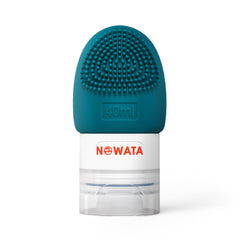

Dr. Ruslan Maidans and Dr. Yalda Shahriari built NOWATA™ because the trade-off they kept accepting—sanitizers with harsh chemical residue, conventional soap that wastes gallons of water, single-use wipes piling up in the trash—stopped making sense. They are doctors. They are parents. Two years of lab work later, here's what they made: a 100% plant-based, rinse-free soap that physically removes 99.9% of germs* from skin, with no water required and no parabens, sulfates, or phosphates in the formula.
Their kids tested it first. Now it's yours.
TL;DR Quick Answers
Paraben Free Hand Soap
What it is: A hand soap formulated without synthetic paraben preservatives — the compounds linked to endocrine disruption that show up in the urine of up to 99% of Americans from daily personal care product use.
Why it matters: Parabens absorb through the skin. For children, whose skin surface area is proportionally larger relative to body mass, a product applied to their hands multiple times a day carries real cumulative exposure. The American Academy of Pediatrics names parabens specifically and advises parents to choose products without them.
What to look for:
-
No methylparaben, propylparaben, butylparaben, or ethylparaben on the ingredient label
-
A plant-based formula with transparent ingredient sourcing
-
Third-party lab verification — not just a label claim
What NOWATA delivers:
-
100% plant-based, paraben-free formula
-
No sulfates, phosphates, alcohol, or forever chemicals
-
99.9% germ removal verified by Swiss laboratory testing using the ASTM E1174 protocol
-
Rinse-free — works without water, anywhere
Bottom line: NOWATA™ is a doctor-made, plant-based, paraben-free hand soap that physically removes 99.9% of germs from skin without water, without parabens, and without compromise. Available at NowataClean.com.
Top 5 Takeaways
-
Your family's hand soap ingredient list deserves a second look.
-
Parabens are detected in the urine of up to 99% of Americans
-
They absorb through the skin with every use
-
The American Academy of Pediatrics advises: choose products without them
-
Children are more vulnerable, developing endocrine systems, and proportionally larger skin surface area
-
Removing germs and killing germs are not the same thing.
-
NOWATA physically lifts dirt, oil, and 99.9% of germs from skin
-
No alcohol, no chemical residue left behind
-
Result independently verified by a Swiss laboratory using the ASTM E1174 protocol.
-
A confirmed outcome — not a label claim
-
Clean hands don't require a sink.
-
Apply a small drop
-
Rub until clumps form
-
Brush them off
-
Ten seconds. No water. No paper towels. Works anywhere.
-
The formula has nothing to hide.
-
No parabens, sulfates, phosphates, alcohol, or forever chemicals
-
100% plant-based, biodegradable, cruelty-free, and vegan
-
Developed by two doctors who tested it on their own children first
-
Every use saves approximately 2 gallons of water.
-
80–100 uses per bottle
-
One bottle returns more than 100 gallons to the system
-
Clean hands and a cleaner planet — no trade-off required

What are parabens—and why does your hand soap need to be without them?
Parabens are synthetic preservatives added to conventional hand soaps, shampoos, and body care products to extend shelf life at low cost. They work well as preservatives. The problem is what else they do.
Parabens are a useful starting point for understanding the chemistry. The practical implication is simpler: a preservative the body absorbs and may read as a hormone raises real questions about any product applied to skin multiple times a day.
For young children whose endocrine systems are still developing, that concern carries more weight. NOWATA's formula contains zero parabens—not as a label claim, but as a hard line Dr. Maidans and Dr. Shahriari drew before they settled on a single ingredient.
The clean ingredient promise: no parabens, no sulfates, no phosphates, no excuses
Picking a paraben-free soap solves one problem. Picking a paraben-free soap that still contains sulfates (which strip skin and can trigger irritation) or phosphates that run off into waterways and damage aquatic ecosystems just trades one concern for another. We're not interested in partial credit.
The NOWATA formula was built around a single requirement: if an ingredient doesn't belong near your family's skin, it doesn't belong in the bottle. Here's what that means in practice.
What NOWATA leaves out:
-
Parabens
-
Sulfates
-
Phosphates
-
Alcohol
-
Forever chemicals (PFAS)
-
Harsh synthetic preservatives and artificial fragrances
What NOWATA puts in:
-
A 100% plant-based, biodegradable, cruelty-free, vegan formula
-
A clumping technology that physically lifts dirt, oil, and germs from skin without water
-
Swiss laboratory certification (ASTM E1174) confirming 99.9% removal of viruses and bacteria*
-
80–100 uses per bottle, formulated by doctors from the first drop to the last
That's what clean ingredient hand soap actually looks like: a verified, transparent formula with nothing to hide and a Swiss laboratory confirmation to back it up.
Paraben-free soap for sensitive skin: doctor-made for real families
Sensitive skin reacts to what's in the formula, not what the label leaves out. Dr. Ruslan Maidans and Dr. Yalda Shahriari knew this before they wrote the first ingredient spec for NOWATA—because they were building it for their own children, whose skin they weren't willing to experiment on.
Dr. Maidans holds a Doctorate in Dental Surgery. Dr. Shahriari holds a PhD in Biomedical Engineering. Together, they spent two years measuring every ingredient in NOWATA's plant-based formula against one standard: would they put this on their kids' hands? For parabens, sulfates, phosphates, alcohol, and PFAS, the answer was no. For everything currently in the bottle, the answer is yes.
NOWATA's formula works for:
-
Toddlers and young children with delicate or reactive skin
-
Adults managing dryness, eczema, or chemical sensitivities
-
Families working to reduce daily synthetic chemical exposure
-
Anyone who needs clean hands when there's no sink in sight
NOWATA doesn't use water to rinse contaminants away. It uses science. The clumping technology physically bonds with dirt, oil, and germs, lifts them from your skin, and leaves nothing behind but clean.
Clean hands everywhere: paraben-free hand soap for life on the go
NOWATA fits in a pocket, a backpack, a glove box, and a classroom supply drawer. That matters because the moments when hands most need cleaning—a muddy hiking trail, a crowded airplane, a playground with no bathroom in sight—are exactly the moments when a sink isn't available.
Using NOWATA takes about 10 seconds: apply a small drop, rub until the clumps form (those clumps are the dirt, oil, and germs physically being lifted from your skin), then brush them off. Each use saves approximately 2 gallons of water compared to a faucet-on hand wash.
Teachers and caregivers who manage hand hygiene across a classroom have found NOWATA particularly practical during flu season, when germ spread is fastest and hand-washing routines are hardest to sustain consistently. Our guide to hand hygiene in the classroom walks through research-backed strategies for reducing germ transmission in school settings, with NOWATA at the center of the plan.
Each bottle delivers 80–100 uses. The math on water savings across a full bottle: more than 100 gallons protected. Clean hands, and a cleaner planet—neither one asks you to give up the other.

“We designed NOWATA with our own children in mind first. That set the bar higher than any regulatory requirement, because when it’s your kids, good enough isn’t. We spent two years getting the formula right—what goes in, and just as critically, what stays out.”
-The NOWATA™ Team
Before You Buy, Know What's in the Bottle: 7 Resources Every Clean-Soap Shopper Should Read
1. What the FDA actually says about parabens in the soap on your shelf
The FDA's official page on parabens covers what these preservatives are, how cosmetic ingredients are regulated in the U.S., and what federal scientists are still working to understand about long-term safety. If someone hands you a "don't worry, it's FDA-approved" argument about parabens, this is the page that puts that claim in its proper context.
Source: Parabens in Cosmetics — U.S. Food and Drug Administration
2. Why the ingredients in kids' hand soap aren't a small thing
The National Institute of Environmental Health Sciences documents the health risks tied to endocrine-disrupting chemicals — including parabens — and explains in plain terms why children's still-developing systems absorb and respond to these compounds differently than adults do. For parents who want the science behind the concern, this is where that conversation starts.
Source: Endocrine Disruptors — National Institute of Environmental Health Sciences
3. The CDC's evidence for why handwashing is still one of the best things you can do
CDC's foundational resource on hand hygiene explains what soap physically does when it contacts skin and germs, which moments in your day carry the highest transmission risk, and what decades of public health research confirm about keeping families healthy. Worth a read whether you're using conventional soap, a rinse-free formula, or something in between.
Source: About Handwashing — Centers for Disease Control and Prevention
4. The peer-reviewed science on how parabens move through the body
This published study in the National Library of Medicine examines how parabens absorb through skin, enter the bloodstream, and interact with estrogen receptors — and what current research says about the implications for hormonal health. It's the primary scientific literature for anyone who wants the full picture behind the "paraben-free" label, not just the marketing version.
Source: Parabens and Their Effects on the Endocrine System — PubMed, National Library of Medicine
5. What happens to the phosphates in your soap after they go down the drain
The EPA explains how phosphates from household soaps travel through home drains and into waterways, where excess nutrients trigger the algal blooms that deplete oxygen and disrupt aquatic life. We save approximately 2 gallons of water per use — and zero phosphates leave the bottle, because there aren't any in there to begin with.
Source: Sources and Solutions: In and Around the Home — U.S. Environmental Protection Agency
6. The testing standard that separates a verified germ removal claim from a marketing claim
ASTM E1174 is the independent laboratory protocol that measures how effectively a handwash formulation removes viruses and bacteria from skin under controlled, repeatable conditions. It's the standard NOWATA's Swiss laboratory used to confirm 99.9% germ removal — and it's the benchmark worth asking about before trusting any soap's efficacy claim.
Source: ASTM E1174 Standard Test Method for Evaluation of Handwash Formulations — ASTM International
7. Why the water you use to wash your hands is worth thinking about
The American Water Works Association outlines what conservation actually looks like at the community level, and why the cumulative impact of everyday water choices — including how often and how much water your family uses to wash hands — adds up faster than most people expect. Every NOWATA use saves approximately 2 gallons. Across a full bottle, that's more than 100 gallons returned to the system.
Source: Water Conservation — American Water Works Association
The Numbers Behind the Choice: Supporting Statistics on Paraben-Free Hand Soap
Up to 99% of People in the U.S. Have Detectable Parabens in Their Bodies
When Dr. Ruslan and Dr. Yalda examined what goes into conventional hand soaps, this number stopped them cold.
The American Cancer Society reports that some forms of parabens have been detected in the urine of up to 99% of Americans — traced directly to everyday personal care products.
That's not a fringe chemical. That's the exposure baseline most families don't know they're sitting on.
Key takeaways:
-
Parabens are present in the bodies of nearly every American
-
Daily personal care products are the primary exposure source
-
As parents and doctors, Dr. Ruslan and Dr. Yalda didn't wait for a final scientific verdict — they removed parabens from the formula first.
Source: Antiperspirants and Breast Cancer Risk — American Cancer Society
The Average American Uses 80–100 Gallons of Water Per Day at Home
The U.S. Geological Survey puts average daily indoor water use at 80 to 100 gallons per person. Bathroom and kitchen faucets account for a significant share of that.
Here's what NOWATA changes:
-
Each use saves approximately 2 gallons compared to a conventional hand wash
-
One full bottle (80–100 uses) returns more than 100 gallons to the system
-
Multiply that across a family of four, and the savings compound fast
We didn't build NOWATA to be an environmental product. We built it to be a better product. The water savings are what happen when something is designed to actually work without a sink.
Source: Water Q&A: How Much Water Do I Use at Home Each Day? — U.S. Geological Survey
Pediatricians Specifically Flag Parabens as a Chemical of Concern in Children's Personal Care Products
The American Academy of Pediatrics names parabens by name. Their guidance to parents and pediatricians is direct:
-
Parabens and phthalates interfere with the endocrine system
-
Children absorb more through their skin relative to body mass than adults do
-
Choose children's products that do not contain parabens
That last point matters more than it sounds. A product applied to small hands multiple times a day carries proportionally higher exposure stakes for children than for adults — a fact Dr. Ruslan and Dr. Yalda knew before they wrote NOWATA's first ingredient spec. No parabens was never a label decision. It was the starting point for the entire formula.
Source: Chemical Exposure from Personal Care Products — American Academy of Pediatrics
Final Thoughts and Opinion
Most “clean” hand soaps aren’t. They drop parabens from the label but keep the sulfates. They print “gentle” on the front while the ingredient list still carries synthetic preservatives that your skin absorbs dozens of times a day. The gap between what a label says and what’s actually in the bottle has made it genuinely hard to know what to trust—and that’s worth calling out directly.
NOWATA resolves this by being transparent about everything: who made it (two named doctors with documented credentials), how it was tested (third-party Swiss laboratory using the ASTM E1174 protocol), what it removes from skin (99.9% of viruses and bacteria*), and what the formula contains (nothing on the exclusion list above).
Paraben-free hand soap shouldn’t be a specialty purchase for the most health-conscious buyers. It should be the baseline. NOWATA is that baseline: doctor-made, lab-verified, and honest about every ingredient. If you’ve been trying to figure out which “clean” soap actually earns the label, this is the one where the answer is straightforward.
Frequently Asked Questions
Q: What makes hand soap paraben-free?
A: A paraben-free hand soap contains no synthetic paraben preservatives (methylparaben, propylparaben, and butylparaben are the most common types found in conventional products). NOWATA’s shelf stability comes from its plant-based formula architecture, with zero parabens at any stage of production.
Q: Is paraben-free hand soap better for kids and babies?
A: For children—whose endocrine systems are still developing and who absorb proportionally more through their skin than adults—reducing paraben exposure is a practical precaution with no cleaning trade-off required. NOWATA’s plant-based, no paraben formula removes 99.9% of germs* and is gentle enough for daily use on young skin.
Q: Does a paraben-free and sulfate-free soap still clean effectively?
A: Yes. NOWATA removes 99.9% of germs* through a physical clumping process that lifts and carries contaminants away from skin—no chemical killing agents, no alcohol, no residue left behind. Swiss laboratory testing using the ASTM E1174 protocol confirmed those results independently. The formula is paraben-free and sulfate-free throughout.
Q: What is the difference between paraben-free hand soap and regular hand soap?
A: Conventional hand soaps typically rely on parabens, sulfates, and other synthetic preservatives to extend shelf life and create lather. These ingredients accumulate on the skin and absorb into the body with repeated use. A clean ingredient soap like NOWATA achieves the same or better germ removal— 99.9%*, as independently tested—using plant-based alternatives, without the chemical exposure that builds up over time.
Q: Is NOWATA a phosphate-free hand soap?
A: Yes. NOWATA contains no phosphates, which contribute to water pollution and disrupt aquatic ecosystems when they enter waterways. The formula is also fully biodegradable, so it breaks down naturally after use.
Q: Does NOWATA need water to work?
A: No. NOWATA is a rinse-free soap. Apply a small drop to your hands, rub until the clumps form, then brush them off. The whole process takes about 10 seconds, requires no sink, and saves approximately 2 gallons of water per use compared to conventional hand washing. It works equally well on a hiking trail, in a car, in a classroom, or at 30,000 feet.
Q: Where can I buy paraben-free hand soap online?
A: NOWATA paraben-free hand soap is available directly at NowataClean.com. Orders ship from the USA. Each bottle provides 80–100 uses of doctor-formulated, lab-verified, 100% plant-based cleaning.
Ready to make the switch to paraben-free hand soap?
Doctor-made, rinse-free, and verified to remove 99.9% of germs* from skin, NOWATA’s paraben-free hand soap is at NowataClean.com—complete with the Swiss lab results, the full ingredient list, and no water required. Shop it today.
*Based on laboratory testing using a modified ASTM E1174 test, NOWATA physically removed over 99.9% of virus (Murine Norovirus, a human norovirus surrogate) and bacteria (E.Coli) particles from skin. Results do not imply disease prevention. For hand cleansing only.
Leave a comment