



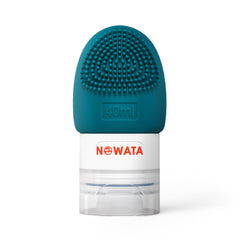

Sticky fingers, a sandbox, and no sink in sight — that’s the exact scenario we built NOWATA™ for. And while we were building it, we kept running into the same question from parents, teachers, and trail runners: what does hand sanitizer actually do to the germs on your skin? The answer shapes everything else in this comparison.
As doctors and parents, we spent two years in a lab working through it. Physical removal and chemical deactivation are not the same — and once you see why, the portable hygiene decision becomes much clearer.
TL;DR Quick Answers
Waterless soap vs hand sanitizer
Waterless soap and hand sanitizer are both portable hand hygiene options. They work in completely different ways — and what each one leaves on your skin tells the full story.
Hand sanitizer:
-
Uses alcohol to chemically disrupt many germs on contact
-
Leaves residue on the skin, including dead pathogen particles and synthetic chemical byproducts
-
Has documented limitations against certain non-enveloped viruses, such as norovirus surrogates
-
Does not physically remove dirt, oil, or debris from the skin
NOWATA waterless soap:
-
Uses clumping technology to physically bond to and remove germs, dirt, and oil from the skin
-
Leaves no residue — contaminants are captured in clumps and brushed away entirely
-
Swiss lab-tested to physically remove over 99.9% of virus and bacteria particles (ASTM E1174)*
-
100% plant-based, alcohol-free, biodegradable, and safe for children
-
No water, no rinsing, no wipe required
Bottom line: Sanitizer deactivates some germs and leaves them on your skin. NOWATA physically removes them.
Top 5 Takeaways
-
Removing germs beats killing them. Sanitizer disrupts some pathogens and leaves the rest on your skin. NOWATA physically removes 99.9% of germs — apply, rub, brush off, done.*
-
Soap wins against the germs families face most. The CDC confirms sanitizer falls short against norovirus, C. difficile, and Cryptosporidium. Physical removal is the stronger mechanism. Full stop.
-
Portable no longer means settling. Sanitizer became the default not because it was better, but because it was the only thing that fit in a pocket. NOWATA changed that.
-
Alcohol-free is a safety decision, not a preference. Poison Help calls involving hand sanitizers jumped 79% in 2020. Most involved young children. NOWATA has no alcohol, no parabens, no harsh chemicals — we tested it on our own kids first.*
-
Every use saves approximately 2 gallons of water. 100% plant-based. Fully biodegradable. 80–100 uses per bottle. Clean hands shouldn't cost the planet anything.

Soap vs Sanitizer Effectiveness: The Core Difference Starts With Mechanism
When you apply alcohol-based hand sanitizer, the alcohol works by denaturing the proteins of harmful pathogens, disrupting their structure enough to render many of them inactive. That sounds effective — and for certain organisms, it is. But here’s what sanitizer doesn’t do: it doesn’t remove anything from your hands. The deactivated germs, the dirt, the oil, and the chemical residue from the sanitizer itself all stay right where they are.
NOWATA works differently. Our plant-based formula uses a clumping technology that physically bonds to dirt, oil, and germs on your skin’s surface, surrounds them, and lifts them away entirely. When you rub your hands together, tiny clumps form that capture everything on the surface. Brush them off, and the germs go with them.
That removing vs. deactivating distinction is the whole foundation of the soap vs hand sanitizer effectiveness debate — and it matters more than most people consider when choosing what goes on their hands.
What that looks like in practice:
-
Hand sanitizer chemically disrupts many bacteria and some viruses, but has documented limitations against certain non-enveloped viruses, and leaves dead cellular debris on the skin.
-
Rinse-free soap like NOWATA physically captures and removes contaminants from the skin surface. Nothing stays behind.
-
The result is a different kind of clean — one that delivers the physical removal power of soap and running water, without needing a drop of either.
Does Soap Remove More Germs Than Sanitizer? Here’s What the Science Says
We didn’t build NOWATA on instinct. We built it in a lab and then tested it the way scientists test things.
NOWATA was independently evaluated by a Swiss laboratory using a modified ASTM E1174 protocol — the accepted standard for assessing hand-cleansing product performance. The result: NOWATA physically removed over 99.9% of virus and bacteria particles from skin, including Murine Norovirus (a human norovirus surrogate) and E. coli.*
Does soap remove more germs than sanitizer? The honest answer depends on what you mean by ‘removes.’ Here’s what the data shows:
-
Traditional soap with running water remains the CDC-recognized benchmark because it physically removes contaminants through surfactant action and rinsing.
-
Alcohol-based sanitizer works against many bacteria and enveloped viruses, but has documented limitations against non-enveloped viruses, and doesn’t remove physical debris from the skin.
-
NOWATA brings the physical removal power of soap and water to a portable, rinse-free format, backed by verified lab data.
Whether soap is better than hand sanitizer has always depended on whether a sink is nearby. NOWATA changes that answer.
Hand Sanitizer vs Soap and Water — And Where Rinse-Free Soap Fits In
The CDC recommends washing hands with soap and running water as the preferred method of hand hygiene. That guidance rests on solid science, and it’s right. Traditional soap works because surfactants physically remove contaminants, mechanical friction scrubs them loose, and rinsing carries them away. When a sink is available, use it.
The problem is that a sink isn’t always available. Playgrounds don’t have them. A trailhead shelter and the backseat of a car don’t either. When you’re in any of those situations, hand sanitizer has historically been the only portable option — not because it’s better than soap and water, but because it was the only thing that fit in a pocket.
We built NOWATA specifically to change that. Once you understand how the clumping mechanism works, the comparison between rinse-free soap vs hand sanitizer becomes straightforward: one delivers portable chemical action, the other delivers portable physical removal. NOWATA belongs in every bag, backpack, and glove compartment for exactly this reason.
The Safest Choice for Families, Kids, and On-the-Go Hygiene
For parents, this question isn’t abstract. Alcohol-based sanitizers carry real concerns with young children: accidental ingestion is a documented risk, alcohol strips moisture from sensitive skin, and the sticky residue left behind is something small hands will inevitably transfer somewhere else.
NOWATA is 100% plant-based with no alcohol, no parabens, no phosphates, and no harsh chemicals. We formulated it with children in mind from day one, because we created it for our own children first. Safe enough for toddler snack hands, tough enough for trail grime. No battles at wash time — and kids are genuinely curious about the clumps. That apply-rub-brush sequence becomes something they actually want to do instead of something you’re coaxing them through.
What parents end up noticing most is the routine itself, not just the formula.
For a closer look at building a safe, plant-based hand hygiene routine for your kids, see our full guide on keeping kids’ hands clean and safe with plant-based soap.
The Environmental Verdict: Rinse-Free Soap vs Hand Sanitizer
The math on this is simple. Every time you use NOWATA instead of a single-use sanitizer wipe, you save approximately two gallons of water. The formula is 100% biodegradable, breaking down naturally without leaving synthetic chemicals in soil or water systems. One bottle delivers 80–100 uses, which reduces the plastic waste from disposable wipes and single-use packets considerably.
Most sanitizer products aren’t designed with environmental responsibility in mind. Many contain synthetic chemicals that don’t break down cleanly, and the packaging footprint of individual-use formats adds up fast. A plant-based, biodegradable rinse-free soap with 80–100 uses per bottle is the straightforward choice when it outperforms the alternative.
We built NOWATA because it was better for your hands. It happens to be better for the planet, too.

“After years of studying how pathogens interact with skin surfaces, the case for physical removal over chemical deactivation became scientifically undeniable — which is precisely why we designed NOWATA around clumping technology rather than alcohol. Removing a germ from the skin entirely is always preferable to leaving its remnants behind.”
— The NOWATA™ Team
Essential Resources on Waterless Soap vs Hand Sanitizer
We believe informed families make better choices. These seven resources come straight from reliable sources — no filler, no fluff. Just the science and safety information are worth bookmarking.
1. The CDC's honest breakdown of when hand sanitizer actually falls short
If you've ever wondered why your pediatrician keeps telling you to wash with soap and water instead of reaching for the gel, this CDC page explains it directly. Certain germs — including norovirus and C. difficile — resist alcohol-based sanitizer entirely. The page also covers child ingestion risks, how much alcohol a sanitizer actually needs to do anything useful, and when the CDC formally recommends soap over sanitizer. Worth reading before you stock up on anything.
Source: https://www.cdc.gov/clean-hands/data-research/facts-stats/hand-sanitizer-facts.html
2. What the FDA actually says about hand sanitizer — including what it legally cannot claim
Hand sanitizers are regulated as over-the-counter drugs by the FDA, not cosmetics. That distinction matters more than most people realize. This page walks you through what the Drug Facts label is required to tell you, what no consumer sanitizer is approved to claim, and specific safety guidance for households with young children. If you're a parent who reads ingredient labels, this one is for you.
Source: https://www.fda.gov/consumers/consumer-updates/safely-using-hand-sanitizer
3. The study that put liquid soap and hand sanitizer head-to-head against norovirus on actual human hands
Researchers tested liquid soap and alcohol-based hand sanitizer directly against the Norwalk virus — a human norovirus surrogate — on human volunteers' finger pads. Liquid soap with water reduced viral particles significantly more than alcohol-based sanitizer, which showed limited effectiveness against this particular virus. This is the peer-reviewed science behind why physical removal and chemical deactivation are not the same thing. Not light reading, but genuinely useful if you want the data.
Source: https://pmc.ncbi.nlm.nih.gov/articles/PMC2805232/
4. The ASTM E1174 testing protocol — the standard that verifies what "99.9%* germ removal" actually means
NOWATA's Swiss lab results are based on a modified version of this protocol. ASTM E1174 is the accepted standard for measuring how effectively a hand-cleansing product reduces transient microbial flora on real skin. Understanding what this test measures — and how it differs from tests used for sanitizers — gives you a much sharper lens for evaluating performance claims on any hand hygiene product you pick up. If a brand makes a germ removal claim, this is the standard they should be citing.
Source: https://www.astm.org/e1174-21.html
5. What the Texas Poison Center Network says about hand sanitizer and young children
This one is for the parents. The Texas Poison Center Network breaks down exactly what happens when a toddler gets into hand sanitizer — the alcohol content thresholds, the ingestion scenarios, when symptoms appear, and when to call Poison Control. It's a straightforward, no-alarm resource that gives you the actual risk picture rather than worst-case headlines. Worth knowing beforehand, hygiene season hits your classroom or playgroup.
Source: https://poisoncontrol.org/hand-sanitizers-how-toxic-are-they/
6. APIC's hand hygiene resource center — how infection prevention professionals actually think about this decision
APIC is the professional organization for people whose full-time job is preventing infection in hospitals and healthcare facilities. Their hand hygiene resources compile the clinical guidance and evidence-based standards used by those professionals to determine when soap, when sanitizer, and when neither is enough. If you want to understand how infection control experts weigh the soap vs. sanitizer decision — beyond the general public guidance — this is where they publish their work.
Source: https://apic.org/resources/topic-specific-infection-prevention/hand-hygiene/
7. America's Poison Centers: national data on hand sanitizer exposures involving children
America's Poison Centers tracks every reported hand sanitizer exposure in the country, including the calls involving children, the volume of emergency department visits, and emerging safety alerts. This isn't a scare tactic page — it's the actual national dataset. For families comparing alcohol-based and alcohol-free hand hygiene options, the numbers here provide real context that product labels rarely do.
Source: https://aapcc.org/Prevention/children
Supporting Statistics
1. Poison Help calls involving hand sanitizers jumped 79% in a single year
The U.S. Health Resources and Services Administration (HRSA) documented a 79% spike in Poison Help calls related to hand sanitizers in 2020 alone. We tracked this data closely while formulating NOWATA. Here's what it told us:
-
Most of those calls involved young children
-
The surge happened as sanitizer became the default portable hygiene option for families.
-
Alcohol ingestion risk in children isn't rare — it's a documented, recurring public health event.
That one statistic became a non-negotiable for us. Alcohol-free wasn't a marketing angle. It was the only responsible starting point for a product designed to live in a family's bag.
2. Soap physically removes 4 in 10 diarrheal illnesses — sanitizer cannot make the same claim
The Global Handwashing Partnership synthesized more than 40 independent studies. The findings shaped how we thought about NOWATA's mechanism from day one:
-
Handwashing with soap prevents approximately 4 in 10 cases of diarrheal illnesses.
-
It reduces respiratory infections by up to 25%
-
Both outcomes are tied to physical removal — not chemical disruption
Sanitizer doesn't produce comparable numbers against the same pathogens. That gap is precisely what we built NOWATA to close — portable physical removal, verified by independent lab testing, available anywhere.
Source: https://globalhandwashing.org/about-handwashing/why-handwashing/health/
3. A standard faucet runs at 2 gallons per minute — the real cost of every traditional handwash
The EPA's WaterSense program puts the standard bathroom faucet flow at approximately 2 gallons per minute. Run the numbers on a typical family's day:
-
A complete handwash takes 20+ seconds of running water
-
The CDC recommends washing hands 8 to 10 times per day
-
A family of four can use 500+ gallons per month on hand hygiene alone
We cite 2 gallons saved per NOWATA use because that's the real-world average for a complete sink handwash — not an estimate, not a best case. NOWATA doesn't ask anyone to wash their hands less. It gives families a genuinely effective option for every moment a sink isn't there.
Source: https://www.epa.gov/watersense/statistics-and-facts
Final Thoughts and Opinion
Look, the mechanics here aren’t complicated. Hand sanitizer disrupts germs chemically. Rinse-free soap removes them physically. One leaves residue on your skin. The other clears it completely. Sanitizer gets a job done when nothing else is available, and we won’t tell you otherwise. But physical removal is the stronger mechanism, and NOWATA puts it in your pocket.
We built this because we wanted something genuinely better for our family — portable, plant-based, and actually tested. Swiss lab-verified, doctor-made, with 80–100 uses per bottle and a formula that’s safe for kids and biodegradable. The trade-off we kept running into — portable hygiene, safe for children, gentle on the planet — turned out to be a problem we could engineer our way out of. So we did.
If hand sanitizer has been your default because it was your only portable option, you’ve got a better one now.
Frequently Asked Questions
Q: Is soap better than hand sanitizer?
A: For everyday hand hygiene, yes — soap that physically removes germs is more thorough than sanitizer that chemically deactivates them. Traditional soap with water and rinse-free soap like NOWATA both work through physical removal, while hand sanitizers disrupt some pathogens but leave residue on your skin, including dead germ particles and chemical byproducts. NOWATA’s independent Swiss lab testing verified 99.9% germ removal using the ASTM E1174 protocol.* That’s a lab result, not a marketing claim.
Q: Does waterless soap actually work without water?
A: Yes, and the mechanism is worth a moment. NOWATA’s clumping technology physically bonds to dirt, oil, and germs on your skin. When you rub your hands together, the formula forms small clumps that capture and lift contaminants away from the skin surface. Brush them off, and they’re gone — no sink, no rinse, no wipe. It’s the same physical removal principle that makes soap and water effective, delivered in a format that doesn’t need running water.
Q: Is NOWATA safe for kids and toddlers?
A: Yes. NOWATA is 100% plant-based and contains no alcohol, parabens, phosphates, or harsh chemicals. We designed it with young children in mind from the start, because we tested it on our own children first. No alcohol ingestion risk, no skin-stripping dryness, and no chemical residue left on little hands. Kid-safe, cruelty-free, and vegan.
Q: Can I use NOWATA instead of hand sanitizer?
A: Absolutely, and by most measures, NOWATA does more. Where hand sanitizer chemically targets some pathogens and leaves residue behind, NOWATA physically removes 99.9% of germs from the skin entirely.* It’s portable, plant-based, alcohol-free, and needs no water, which makes it a practical everyday replacement for alcohol sanitizer at home, on the trail, in the classroom, or anywhere else.
Q: How many uses does one bottle of NOWATA provide?
A: Each bottle delivers approximately 80–100 uses. That works out to under twenty cents per use. It ships free on orders over $45 and comes with a 30-day satisfaction guarantee, so there’s very little reason not to try it.
Ready to Replace Your Sanitizer With Something That Actually Removes Germs?
Try NOWATA™ for 30 days, risk-free — doctor-made, 100% plant-based, and Swiss lab-verified to physically remove 99.9% of germs with no water required.* Join the families, hikers, and teachers who’ve made the switch — shop NOWATA Soap with free shipping on orders over $45.
*Based on laboratory testing using a modified ASTM E1174 test, NOWATA physically removed over 99.9% of virus (Murine Norovirus, a human norovirus surrogate) and bacteria (E.Coli) particles from skin. Results do not imply disease prevention. For hand cleansing only.
Leave a comment