



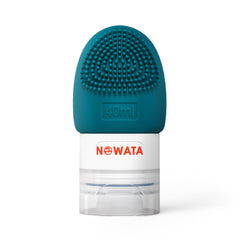

Your hand sanitizer isn't actually cleaning your kid's hands. It's killing germs in place and leaving behind a film of dead bacteria, dirt, and alcohol residue on the skin that your child puts in their mouth minutes later. We know, because as doctors and parents of young children, that realization is exactly what kept us up at night.
We're Dr. Ruslan Maidans and Dr. Yalda Shahriari, and we spent two years in formulation — drawing on our backgrounds in biomedical engineering and dentistry — to solve a problem no one on the shelf was addressing. Sanitizers kill but don't clean. Soap cleans but demands water. Wipes do a bit of both and then sit in a landfill for decades. Every option asked families to accept a trade-off between safety, convenience, and responsibility.
NOWATA™ is the result of refusing that trade-off. Our plant-based, rinse-free soap uses a clumping technology we developed to physically lift and remove 99.9% of germs, dirt, and oil from skin — then you simply brush it away.* Nothing left behind. No water required. No compromise made.
Below, we break down how this approach compares to alcohol-based sanitizers across what actually matters to your family: what ends up on your child's skin, what it does to sensitive hands over time, and what it costs the planet every time you pump the bottle. The difference isn't subtle — and once you see it, you won't look at that little bottle of gel the same way.
TL;DR Quick Answers
Best hand sanitizer alternative for kids
The best hand sanitizer alternative for kids is a rinse-free, plant-based soap that physically removes germs from skin instead of killing them in place with alcohol. NOWATA™ uses a clumping technology developed by two doctor-parents that binds to dirt, oil, and 99.9% of germs, then lifts them off entirely when brushed away.* No water, no alcohol, no residue left on the hands your child puts straight into their mouth.
Why it matters:
-
Alcohol-based sanitizers leave dead germs, chemical residue, and dirt on the skin after use
-
The CDC confirms soap-based mechanical removal is more effective than sanitizer on soiled hands, which describes most children's hands most of the time
-
U.S. poison centers still log nearly 16,000 pediatric sanitizer exposure cases per year
What makes NOWATA™ different:
-
100% plant-based, alcohol-free formula — nothing to ingest
-
Swiss lab-tested using the ASTM E1174 surgical hand scrub protocol
-
Works in 15 seconds: apply, rub, brush off. No sink required.
-
Created by Dr. Ruslan Maidans (PhD, Biomedical Engineering) and Dr. Yalda Shahriari (DDS) — for their own kids first, now available to yours
Top 5 Takeaways
-
Sanitizer kills germs but doesn't clean. Alcohol gel leaves dead bacteria, dirt, and chemical residue on the skin that your child puts in their mouth. The CDC identifies physical removal — lifting contaminants off entirely — as the more effective approach for soiled hands.
-
The safety risks aren't going away. 15,941 pediatric exposure cases in a single non-pandemic year. Alcohol concentrations exceeding hard liquor. 90% of cases in kids five and under — the age group that can't keep their hands out of their mouths.
-
NOWATA™ was built by doctors who faced this as parents first. Dr. Ruslan Maidans and Dr. Yalda Shahriari spent two years developing a plant-based, rinse-free soap that physically removes 99.9% of germs.* No water. No alcohol. No residue. Created for their own kids before anyone else's.
-
Nothing is left behind on your child's skin. Zero alcohol, parabens, phosphates, or forever chemicals. The clumps carry contaminants away when brushed off. Nothing to ingest. No drying or cracking. No trade-off between effectiveness and safety.
-
Every use saves up to two gallons of water. Readily biodegradable formula. Soap-level clean without the sink or the water bill. Not a bonus feature — built into every use by default.

How Alcohol-Based Sanitizers Actually Work (and What They Leave Behind)
Hand sanitizers earned a permanent spot in every bag and pocket during the pandemic — and for good reason. Alcohol-based gels are fast, portable, and effective at killing many common bacteria and viruses on contact.
But killing isn't the same as cleaning. When you apply a standard alcohol gel, it destroys the cell walls of germs on the skin's surface. The germs die, but they don't disappear. The dead microbial matter, along with whatever dirt, food residue, and oils were already on your hands, stays right where it was. The alcohol evaporates, and what remains is a thin, invisible film of everything you were trying to get rid of — minus the living germs.
For adults in a pinch, that may be an acceptable trade-off. For toddlers who put their hands in their mouths seconds later, or kids with eczema-prone skin reacting to repeated alcohol exposure, it raises a fair question: Is there a better way?
What "Physically Removes" Means — and Why It Matters for Kids
NOWATA™ works on an entirely different principle. Rather than using alcohol to kill germs chemically, our rinse-free soap uses a plant-based clumping technology that binds to dirt, oil, and 99.9% of germs on the skin's surface, then lifts them away physically.* You rub it in, the formula clusters around contaminants, and you brush or wipe the clumps off. The germs leave your child's hands entirely — they aren't just neutralized in place.
Think of it as the difference between spraying disinfectant on a muddy countertop and actually wiping the mud away. One sterilizes the mess. The other removes it. Families shouldn't have to choose between the two, and with NOWATA, they don't.
This clumping mechanism was developed over two years of formulation by Dr. Ruslan Maidans (PhD, Biomedical Engineering) and Dr. Yalda Shahriari (DDS), then verified through independent Swiss laboratory testing using a modified ASTM E1174 protocol — the same standard used to evaluate surgical hand scrubs.
The Ingredient Difference: Plant-Based Formula vs. Alcohol Gel
Most conventional hand sanitizers rely on 60–70% ethyl or isopropyl alcohol as their active ingredient. That concentration is what makes them effective — and also what makes them harsh. Repeated use strips natural oils from the skin, leading to dryness, cracking, and irritation, particularly on young or sensitive skin. Some formulas add synthetic fragrances, parabens, or preservatives to offset the drying effect, introducing additional ingredients many parents prefer to avoid.
NOWATA's formula is 100% plant-based, readily biodegradable, and free of alcohol, parabens, phosphates, and forever chemicals. It's designed to be gentle enough for toddler hands while still delivering lab-verified germ removal. No fragrance masking harsh chemistry. No moisture-stripping trade-off. Just clean hands from clean ingredients — a distinction that matters when those hands go straight from the product to a snack, a pacifier, or a sibling's face.
Convenience Without the Compromise
One of the reasons sanitizers became so widespread is sheer convenience — no sink required. NOWATA matches that portability and raises it. Our rinse-free soap needs no water, no rinsing, and no towel to dry off afterward. Apply, rub, brush off, done. Three steps, roughly fifteen seconds, anywhere.
That means it works equally well at a rest stop on a road trip, mid-hike on a trail with no facilities, in a classroom before snack time, or at the playground when the nearest bathroom is a five-minute walk your toddler will not cooperate with. Each bottle delivers 80 to 100 uses, fits in a diaper bag pocket or a backpack side pouch, and doesn't leak sticky gel all over everything it touches.
What It Means for the Planet
Here's a number worth sitting with: the average person uses roughly a gallon and a half of water every time they wash their hands at a sink. Multiply that by a family of four, several washes a day, 365 days a year — and the volume adds up fast.
Every use of NOWATA saves up to two gallons of water. Over the life of a single bottle, that's a meaningful reduction in household water consumption, delivered without any extra effort or lifestyle change. The formula itself is fully biodegradable and breaks down naturally, and the product is cruelty-free and vegan. Sustainability here isn't a bonus feature — it's built into every use by default.
Side-by-Side: Rinse-Free Plant-Based Soap vs. Alcohol Gel
The differences between NOWATA™ and standard alcohol gel become clear when you compare them across the factors families care about most.
How they handle germs. NOWATA physically removes 99.9% of germs from the skin's surface through clumping technology — they leave your hands entirely.* Alcohol gel kills germs on contact, but leaves the dead microbial matter, dirt, and residue sitting right where it was.
What's inside. NOWATA's formula is 100% plant-based with no alcohol, parabens, phosphates, or harsh chemicals. Most conventional sanitizers rely on 60–70% alcohol as their active ingredient, often alongside synthetic fragrances and preservatives.
How do they treat skin? NOWATA is gentle enough for toddler hands and won't cause drying or cracking with regular use. Alcohol-based gels strip natural oils from the skin over time, leading to irritation — especially on young or sensitive skin.
What they actually clean. NOWATA lifts and removes dirt, oil, and grime along with germs. Sanitizers only target microbes and have no effect on the visible mess on your child's hands.
What they leave behind. Nothing, in NOWATA's case — the clumps are brushed away, and the contaminants go with them. Alcohol gel leaves a film of dead bacteria, residue, and whatever else was on the skin before application.
Water and environmental impact. Neither requires water, but NOWATA goes further — each use saves up to two gallons compared to a traditional sink wash, and the formula is fully biodegradable. Most alcohol gel packaging is non-biodegradable, and the product itself offers no water-saving benefit.
Lab verification. NOWATA's germ removal claims are verified by independent Swiss laboratory testing using the ASTM E1174 protocol, the same standard applied to surgical hand scrubs. Sanitizer testing standards vary significantly by brand.
Safety around kids. NOWATA's plant-based formula carries no ingestion risk from harsh chemicals. Alcohol-based sanitizers pose a documented poisoning risk if young children consume even small amounts — a concern the CDC has flagged repeatedly.
Who NOWATA Is Made For
We created this product as parents first — for the specific moments that every caregiver recognizes. But the use cases extend well beyond the diaper bag.
Parents and caregivers reach for NOWATA at playgrounds, in the car, at restaurants, and during the nightly "did you wash your hands" negotiation. It turns a battle into a fifteen-second activity kids actually find fun — they like watching the clumps form.
Outdoor enthusiasts pack it for backcountry trips, day hikes, camping, and festivals where water access is limited or nonexistent. It handles trail grime and muddy hands, not just germs.
Teachers and childcare providers use it to keep classroom hand hygiene fast and consistent, especially during cold and flu season, without lining kids up at a sink and losing ten minutes of instruction time.
Travelers keep it in carry-ons, hotel kits, and road trip bags for the dozens of moments between proper hand-washing opportunities that every trip inevitably delivers.

"As doctors, we understood the science behind sanitizers — but as parents, we couldn't accept a product that left dead germs, chemical residue, and dirt on the hands our kids put straight into their mouths. NOWATA exists because we built what we couldn't find on the shelf: a soap that actually removes what you're trying to get rid of."
— Dr. Ruslan Maidans & Dr. Yalda Shahriari, NOWATA™ Founders
7 Resources We Wish We'd Had Before We Built NOWATA™
We spent two years researching hand hygiene before we ever formulated a product. As doctors — and as parents who were tired of choosing between "effective" and "safe enough for our kids" — we read everything we could find from the agencies and organizations that set the standard.
Here are the seven resources that shaped our thinking. We're sharing them because the same evidence that led us to create NOWATA™ is the evidence that will help you decide what belongs in your family's bag. Read them. We're confident about where you'll land.
1. What the CDC Actually Recommends for Children's Hand Hygiene
If there's one resource to start with, it's this one. The CDC's guidance for schools and childcare settings is clear: hand sanitizer is not a substitute for soap-based cleaning, and children under six need direct adult supervision when using alcohol-based products. This is the baseline we measured ourselves against when developing NOWATA — and the standard every hand hygiene product should meet.
Source: Centers for Disease Control and Prevention — Hand Hygiene in Schools and Early Care and Education Settings URL: https://www.cdc.gov/clean-hands/prevention/about-hand-hygiene-in-schools-and-early-care-and-education-settings.html
2. Why Pediatricians Flag Hand Sanitizers as a Poisoning Risk for Kids
This one hit differently once we became parents. The American Academy of Pediatrics reports that hand sanitizer ingestion cases among young children numbered in the tens of thousands annually during the pandemic, because alcohol gel is colorful, sometimes scented, and not sold in child-resistant packaging. When we were designing NOWATA's plant-based formula, eliminating alcohol ingestion risk wasn't a feature we added. It was a problem we refused to carry forward.
Source: HealthyChildren.org (American Academy of Pediatrics) — Hand Sanitizers: Keep Children Safe from Poisoning Risk URL: https://www.healthychildren.org/English/health-issues/conditions/COVID-19/Pages/Keep-Hand-Sanitizer-Out-of-Childrens-Reach.aspx
3. When Sanitizer Isn't Enough: The AAP on Why Dirty Hands Need More Than Alcohol
Here's the thing the AAP says out loud that most sanitizer brands would rather you not think about: soap and water outperform alcohol-based products when hands are visibly dirty. And as any parent knows, kids' hands are almost always visibly dirty. That gap — between what sanitizers handle and what children's hands actually need — is the exact space NOWATA was built to fill. Physically removing germs, dirt, and oil, no sink required.
Source: HealthyChildren.org (American Academy of Pediatrics) — Hand Washing: A Powerful Antidote to Illness URL: https://www.healthychildren.org/English/health-issues/conditions/prevention/Pages/Hand-Washing-A-Powerful-Antidote-to-Illness.aspx
4. The Science Behind Physical Removal vs. Chemical Killing
This is the resource Dr. Ruslan points people to when they ask, "But doesn't sanitizer work?" The CDC's research summary explains exactly how soap and friction physically lift germs from skin — and presents peer-reviewed evidence that sanitizers lose effectiveness on soiled hands. Our clumping technology was inspired by this same mechanical principle: bind to the contaminants, lift them off, take them away. The science isn't complicated. It just hadn't been made portable until now.
Source: Centers for Disease Control and Prevention — Handwashing Facts and Scientific Evidence URL: https://www.cdc.gov/clean-hands/data-research/facts-stats/index.html
5. What Poison Control Wants You to Know About Alcohol Gel Around Kids
Fair warning — this one might change how you feel about the bottle in your diaper bag. Poison Control's guide reveals that standard 60% hand sanitizer is as concentrated as 120-proof liquor, walks through real pediatric exposure cases, and confirms that alcohol gel doesn't even work against norovirus — the stomach bug that rips through daycares and schools every year. We didn't build NOWATA to compete with sanitizer. We built it because we read resources like this one and realized our kids deserved something fundamentally different.
Source: National Capital Poison Center — Hand Sanitizer: What's the Real Story? URL: https://www.poison.org/articles/hand-sanitizer-whats-the-real-story
6. How to Look Up What's Really in Any Hand Hygiene Product (Including Ours)
We love the Environmental Working Group's Skin Deep database because it does exactly what we believe in: transparency. Search any hand sanitizer or hygiene product by name, and you'll see safety scores for every ingredient — including the fragrances, preservatives, and synthetic additives that the front label never mentions. We encourage you to look up what's currently in your bag. Then look up what's in NOWATA. We're 100% plant-based with nothing to hide. 🌱
Source: EWG Skin Deep® — Hand Sanitizer Product Safety Ratings URL: https://www.ewg.org/skindeep/browse/category/hand_sanitizer/
7. The Water Cost of Traditional Handwashing (It's More Than You Think)
Every time your family washes hands at a sink, roughly a gallon and a half of water goes down the drain. The EPA's WaterSense program puts that number in context alongside all the other daily water use in your home — and the totals add up faster than most people expect. We're not here to guilt anyone about washing their hands. But we did design NOWATA to save up to two gallons per use, because doing right by your family and doing right by the planet shouldn't require separate products. 💧
Source: U.S. Environmental Protection Agency — WaterSense Statistics and Facts URL: https://www.epa.gov/watersense/statistics-and-facts
What the Data Told Us Before We Ever Made a Product
Before NOWATA™ had a formula, a name, or a company, we were two doctors reading CDC reports at our kitchen table while our kids slept upstairs. What we found in that research is what made us start formulating.
Three statistics changed the direction of our careers.
1. 15,941 Pediatric Exposure Cases in a Single Year
We expected the hand sanitizer poisoning numbers to be a pandemic-era spike. They weren't.
Between April 2023 and March 2024, U.S. poison centers managed 15,941 hand sanitizer exposure cases in children 12 and younger — in a non-pandemic year. The reason is straightforward: most hand sanitizers contain alcohol concentrations higher than hard liquor, and even a small swallowed amount can poison a child.
What this meant for our family:
We stopped using sanitizer on our own kids that week. Not because it didn't kill germs — it did. But "effective germ killer that doubles as a documented poisoning risk" wasn't a trade-off we'd accept for our toddlers.
What it meant for NOWATA:
A 100% plant-based, alcohol-free formula stopped being a preference and became a non-negotiable.
Source: America's Poison Centers — National Poison Data System
URL: https://www.poisonhelp.org/hand-sanitizer/
2. 30% Fewer Diarrheal Illnesses. 20% Fewer Respiratory Infections. From Soap — Not Sanitizer.
Early in formulation, we hypothesized that physically removing contaminants would outperform chemically killing them — especially on children's hands, which are rarely clean and dry. The CDC's published data confirmed it.
Soap-based handwashing prevents approximately 30% of diarrhea-related sickness and about 20% of respiratory infections like colds. For school-age kids, the impact is even more concrete: soap-based hygiene reduces gastrointestinal illness-related absenteeism in schoolchildren by 29–57%.
The key distinction:
Those numbers aren't about sanitizer. They're about what soap does differently — the mechanical process of lifting germs off skin, not killing them in place.
How this shaped our product:
-
NOWATA's clumping technology replicates what soap and water do at a sink
-
Our formula binds to contaminants, lifts them from skin, and carries them away completely
-
The CDC's data validated the principle. Our two years of lab work made it portable.
Source: Centers for Disease Control and Prevention — Handwashing Facts
URL: https://www.cdc.gov/clean-hands/data-research/facts-stats/index.html
3. 85,000 Pediatric Poison Control Calls in Five Years — and 90% Were Kids Under Five
Individual years can be dismissed as outliers. A five-year trend can't.
Between 2011 and 2015, U.S. poison control centers received nearly 85,000 calls about hand sanitizer exposures among children. Roughly 90% of those pediatric exposures occurred in children aged five and under, according to the CDC — the exact age group that puts their hands in their mouths seconds after application.
What we recognized that most product developers wouldn't:
As a biomedical engineer (Ruslan) and a dentist who treats pediatric patients (Yalda), the pattern was clear. The problem wasn't misuse. It was the product category itself:
-
Alcohol gel is designed to leave residue on the skin
-
Toddlers are designed to put their hands in their mouths
-
No amount of supervision changes that behavior in a two-year-old
Our design response:
Instead of mitigating the risk with child-proof caps, bitter additives, and smaller bottles, we eliminated it:
-
NOWATA leaves nothing behind on the skin
-
The clumps carry contaminants away entirely
-
No residue to ingest. No chemical film to transfer. No window of exposure.
That's not a marketing angle. That's two doctors reading five years of poison control data and building what their own kids needed.
Source: CDC — Hand Sanitizer Facts
URL: https://www.cdc.gov/clean-hands/data-research/facts-stats/hand-sanitizer-facts.html
Final Thoughts and Opinion
The search for a "best hand sanitizer alternative" usually leads to a shelf full of products that solve the same problem the same way — alcohol in slightly different packaging. We looked at that shelf as doctors. Then we looked at it as parents. And we realized the answer wasn't a better version of what already existed. It was something fundamentally different.
Here's what the evidence told us:
The problem with sanitizers isn't that they don't work. They kill germs effectively. But killing germs in place and actually cleaning your child's hands are two different things — and every major health authority, from the CDC to the AAP, draws that same distinction.
The risks aren't hypothetical. Nearly 16,000 pediatric poison center cases in a single recent year. Alcohol concentrations exceeding hard liquor. A product category designed to leave residue on the skin of children who put their hands in their mouths constantly.
The science points in a clear direction. Soap-based mechanical removal — physically lifting germs, dirt, and oil from skin — is what reduces illness transmission by 20–30% in the CDC's own published data. That's the principle NOWATA was built on.
What We Built and Why
NOWATA™ exists because we refused to choose between:
-
Effective and safe for kids
-
Convenient and actually clean
-
Portable and gentle on sensitive skin
-
Good for our family and good for the planet
Our plant-based clumping technology physically removes 99.9% of germs, dirt, and oil from skin — then you brush it away.* Nothing left behind. No water required. No alcohol. No residue. No compromise.
Three Things to Take Away
-
Read the evidence yourself. We've linked every statistic and resource in this article to its original .gov or .org source. The same data that led us to create NOWATA is available to every parent making this decision.
-
Check what's in your current product. Look up any hand sanitizer on EWG's Skin Deep database. Read the ingredient list — not just the front label. Know what's going on with your child's skin.
-
Ask the right question. The best hand hygiene option for your family isn't the one that kills the most germs. It's the one that removes them — safely, completely, and without trade-offs you shouldn't have to make.
Ready to Make the Switch? Here's What to Do Next.
You've seen the research. You've seen the data. Here are five steps to put it into action.
1. Check What's Currently in Your Bag
Flip over whatever hand hygiene product your family uses right now.
-
Check the alcohol percentage. 60%+ means a concentration stronger than hard liquor on your child's hands.
-
Read the inactive ingredients. Fragrances, parabens, and synthetic preservatives rarely make the front label.
-
Look it up. Search for any product by name on EWG's Skin Deep database — it takes 30 seconds.
Knowing what you're replacing makes the decision easier.
2. Try NOWATA™ With Your Family
The best way to understand the difference between killing germs and removing them is to feel it yourself.
-
Visit nowataclean.com and order your first bottle
-
Use it with your kids watching — apply, rub until clumps form, brush off
-
Put it wherever your old sanitizer lived: diaper bag, car console, backpack, kitchen counter
One bottle. 80–100 uses. Weeks of clean hands.
3. See the Difference
Within the first few days, pay attention to three things:
-
After each use: No sticky residue. No alcohol smell. No film. Just clean skin.
-
Over time: No drying, cracking, or irritation — even on sensitive and eczema-prone skin.
-
In your head: No more wondering if they'll put their hands in their mouth before the sanitizer dries. Nothing on their hands to worry about.
4. Go Deeper on the Research
Every claim in this article links to its source. Start here:
-
CDC hand hygiene guidelines for children — the baseline standard
-
America's Poison Centers sanitizer data — current pediatric exposure numbers
-
CDC handwashing science — physical removal vs. chemical killing
We built NOWATA on this evidence. It speaks for itself.
5. Share What You've Learned
If this changes how you think about what goes on your family's hands, someone in your circle needs to see it.
-
Send it to your parenting group chat. The poison control numbers alone are worth the share.
-
Tag us @nowataclean on Instagram, TikTok, or Facebook. Show us your family's first clump reveal.
-
Tell your child's teacher or daycare provider. Classroom hygiene is one of our most requested use cases, especially during cold and flu season.
Frequently Asked Questions
Q: What can I use instead of hand sanitizer on my child's hands?
A: A product that physically removes germs from skin — not one that kills them and leaves everything behind.
This is the question that launched two years of formulation in our lab. As doctors, we knew the answer wasn't a different sanitizer. Every alcohol-based option works the same way: kill germs chemically, leave the residue on skin. We needed something that did what soap does at a sink — without the sink.
How NOWATA™ works differently:
-
Plant-based clumping technology binds to dirt, oil, and 99.9% of germs on skin*
-
You rub it in, the formula clusters around contaminants, you brush the clumps away
-
Germs don't just die in place — they leave your child's hands entirely
-
No water. No rinsing. No residue.
We built this on a principle the CDC's own research supports: mechanical removal — not chemical killing — drives the broadest reduction in illness transmission. We didn't invent that science. We made it portable.
Q: Is hand sanitizer actually safe for kids?
A: Officially, yes — "when used as directed." As parents of toddlers, we can tell you "as directed" assumes a level of compliance no two-year-old has ever demonstrated.
What the data shows:
-
15,941 pediatric exposure cases logged by poison centers between April 2023 and March 2024 — a non-pandemic year
-
85,000+ calls about pediatric sanitizer exposures between 2011 and 2015
-
90% of those cases involved children five and under
-
Most sanitizers contain alcohol concentrations exceeding hard liquor
What we recognized as a biomedical engineer and a pediatric dentist:
Alcohol gel is designed to leave residue on the skin. Young children are designed to put their hands in their mouths. Those two realities don't coexist safely, no matter how many warning labels you add.
What we did about it:
We didn't build NOWATA to be a "safer sanitizer." We eliminated the conflict. Our formula is 100% plant-based with zero alcohol. Nothing stays on the skin after use. No residue to ingest. No window of risk between application and the next time a small hand reaches for a snack.
Q: Does rinse-free soap work as well as hand sanitizer at removing germs?
A: Yes — and it does something sanitizer can't do at all.
We hear this question at every trade show, and it reveals how deeply the industry has trained people to equate "killing germs" with "clean hands." They're not the same thing.
NOWATA's lab results:
-
Tested by an independent Swiss laboratory using a modified ASTM E1174 protocol
-
The same standard applies to surgical hand scrubs
-
Physically removed over 99.9% of tested virus and bacteria particles from skin*
What NOWATA does that sanitizer doesn't:
-
Removes dirt, food residue, and oil — not just microbes
-
Works on visibly soiled hands — the exact condition where the CDC says sanitizers lose effectiveness
-
Leaves nothing behind on skin — no dead bacteria, no alcohol film, no residue
That CDC caveat about soiled hands isn't minor. It's a description of children's hands roughly 90% of the time. We designed NOWATA to work precisely in those conditions, because those were the real conditions our own kids' hands were in every single day.
Q: What ingredients should I avoid in hand hygiene products for children?
A: Flip the bottle over. Read the back, not the front.
Before NOWATA existed, Yalda started doing exactly this at the store — reading the full ingredient list out loud. What she found in most children's hand sanitizers:
-
Active ingredient: 60–70% ethanol or isopropyl alcohol
-
Inactive ingredients are rarely on the front label: synthetic fragrances, parabens, phosphates, preservatives
All of it is going directly onto your child's skin. And inevitably, into their mouth.
The standard we applied to our own formula:
If we wouldn't want it in our toddler's mouth, it didn't go in the product. Simple.
What's in NOWATA:
-
100% plant-based
-
Readily Biodegradable
-
Zero alcohol, parabens, phosphates, or forever chemicals
What you can do right now:
Search any product — including ours — on the EWG Skin Deep database. It takes 30 seconds. We're confident in what you'll find.
Q: How does NOWATA™ work without water?
A: Ruslan gets asked this at nearly every event. His answer: "The same way soap works. We just removed the part that requires plumbing."
The science behind it:
The CDC describes soap's effectiveness as a function of friction and binding. Soap molecules attach to contaminants. Running water carries them away. Our two years of formulation focused on one question: what if the formula itself could do what the water does?
Three steps. Fifteen seconds.
-
Apply a small drop to dry hands.
-
Rub until the formula visibly clumps — it's binding to dirt, oil, and germs on the skin's surface.
-
Brush off the clumps — contaminants leave with them. Hands are clean.
No rinsing. No towel. No sink.
We tested this in our own home long before it went to a Swiss lab — on post-playground hands, post-camping hands, post-"I just touched the bottom of my shoe" hands. The mechanism works because mechanical removal doesn't require water. It requires binding and separation. NOWATA provides both.
What you get:
-
80–100 uses per bottle
-
Fits in a diaper bag, backpack, car console, or pocket
-
Works at playgrounds, on trails, in classrooms, at rest stops
-
Anywhere your family needs clean hands, and a faucet isn't within reach
Which, if your family is anything like ours, is most of the time.
The Best Hand Sanitizer Alternative Isn't a Better Sanitizer — It's NOWATA™
Your family deserves clean hands without alcohol residue, chemical trade-offs, or a sink that's never there when you need it. Try NOWATA today at nowataclean.com and discover why thousands of parents are making the switch to rinse-free, plant-based soap that physically removes what alcohol gel leaves behind.
*Based on laboratory testing using a modified ASTM E1174 test, NOWATA physically removed over 99.9% of virus (Murine Norovirus, a human norovirus surrogate) and bacteria (E.Coli) particles from skin. Results do not imply disease prevention. For hand cleansing only.
Leave a comment