



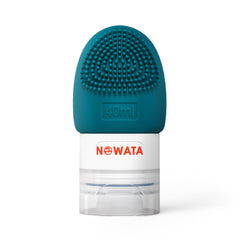

You can clean your hands without water. We figured that out the long way: two years of testing in our home and a Swiss lab, because we'd lost patience with the alternatives we kept reaching for as parents — sanitizer that left chemicals on our kids' skin, soap that wasted gallons at every sink, and wipes that filled a trash bag every weekend. This guide is the long version of how rinse-free hand washing works, when to use it, and how a plant-based, doctor-made soap can physically remove dirt, oil, and over 99.9% of germs without a single drop of water.
TL;DR Quick Answers
How To Clean Hands Without Water
Apply a dime-sized drop of rinse-free soap to dry palms, rub for 15 to 20 seconds until clumps form with the dirt and oils on your skin, then brush the clumps off. Plant-based no-rinse soaps like NOWATA™ are lab-tested to physically remove over 99.9% of bacteria and viral particles, leaving hands genuinely clean without water or residue.*
In short:
-
Apply: one drop of plant-based, rinse-free soap on dry hands.
-
Rub: 15 to 20 seconds, until the soap clumps with the grime.
-
Brush off: the clumps wipe right off, and your hands feel clean and soft.
Top 5 Takeaways
-
You really can clean your hands without water. Rinse-free soaps use plant-based surfactants and absorbent powders to physically lift dirt, oils, and microbes off your skin.
-
Removing germs works better than trying to deactivate them in place. Sanitizers leave residue and dead microbe debris behind. Rinse-free soap takes both with you when the clumps brush off.
-
The 99.9% claim comes from independent Swiss lab testing. Under a modified ASTM E1174 protocol, NOWATA physically removed over 99.9% of E. coli and a norovirus surrogate from skin.*
-
Every wash saves water. A typical sink wash uses 1.5 gallons or more, and a single tube of NOWATA replaces over 100 gallons of soap-and-sink time.
-
Built by parents who happen to be doctors. NOWATA is 100% plant-based and alcohol-free, gentle enough for toddler snack hands and tough enough for trail grime.

Why Waterless Hand Washing Is Suddenly A Smart Idea
Hand washing has been a public-health staple since the 1840s, when Dr. Ignaz Semmelweis showed that doctors washing their hands between patients dramatically reduced infection rates. The principle hasn't changed in 180 years. What changes is whether a sink is actually within reach when you need to wash.
Soap and running water remain the recognized public-health standard, and we're not here to argue with that. For anyone who wants the long view, the broader history and science of hand washing traces how the practice evolved from Semmelweis to current protocols. The real-world question is what to do when a sink isn't an option, and that's the gap rinse-free hand washing was built to close.
Then there's the water itself. A typical sink-wash runs through 1.5 to 2 gallons. For a household of four, that adds up to over 2,000 gallons a year on hand washing alone. Cutting half of that without sacrificing cleanliness adds up faster than most people expect.
Outdoor enthusiasts run the same math from a different angle. No rinse means no runoff into streams, no wasted gallons at a campsite spigot, and one less plastic bottle of something harsh in the pack. We covered the trail-tested side of the story in our piece on biodegradable, eco-friendly soap built for camping and backcountry use.
How No-Rinse Hand Washing Actually Works
Conventional hand sanitizer uses alcohol to denature proteins on bacterial and viral surfaces. It works on some pathogens but fails on others (norovirus and C. difficile spores both resist alcohol cleanly), and the dead microbe debris, dirt, and oils all stay on your skin afterward. That's the source of the sticky-hands feeling. Wipes physically pick up some material, but they're a single-use waste stream, and the cleaning agents inside them are usually limited.
Rinse-free soaps work on a completely different principle: mechanical removal. The formula combines plant-based surfactants with absorbent powders like kaolin clay, tapioca starch, and coconut milk powder. As you rub your hands, the formula binds with dirt, skin oils, and microbes, then physically clumps. You brush the clumps off, and what was on your hands is now physically gone.
This matters because the U.S. Centers for Disease Control and Prevention has consistently identified physical removal as the most effective approach to reducing the transmission of viral and bacterial pathogens. An independent Swiss laboratory tested NOWATA's formula under a modified ASTM E1174 protocol, the same method used to evaluate clinical hand washes. The lab measured physical removal of over 99.9% of E. coli and Murine Norovirus (a human norovirus surrogate) particles from skin.*
If you want the longer version of how the formula was developed and what the lab actually measured, we wrote that up separately in our explainer on Swiss lab-tested waterless no-rinse hand wash soap.
When Waterless Hand Cleaning Becomes Your Best Option
Some moments don't come with a sink. These are the situations where rinse-free soap stops being a backup and starts being the right tool for the job:
-
Parenting on the go. Playgrounds, parking lots, the back of the minivan, post-popsicle, post-petting-zoo. None of those moments comes with a sink, and you don't want sanitizer becoming your toddler's next taste test.
-
Outdoor adventures. Hiking, camping, climbing, kayaking, hunting. Water is heavy in a pack, and a tube of rinse-free soap weighs almost nothing. It also works when your hands are visibly muddy or greasy, which is when sanitizer falls apart.
-
Travel. Airports, trains, road trips, layovers, cruise excursions. Airplane bathrooms aren't where you want to spend extra time.
-
Classrooms and childcare. Teachers move classrooms of 25-plus kids through hand cleaning between activities, and a no-rinse method takes a fraction of the time.
-
Festivals and events. Portable toilets and questionable hand-washing stations are the rule, not the exception.
If you're heading into festival season or a long camping weekend, we wrote a deeper guide to portable rinse-free hand soap built for travel, camping, and outdoor adventures, with pack lists and travel-friendly bottle sizes.
One honest caveat. When you have a sink,k and your hands are visibly soiled with something biological (raw meat, bodily fluids, garden compost), the CDC still recommends soap and water — and we agree. Rinse-free soap is the right tool for the other 80% of moments, when a sink isn't realistic.
The 3-Step NOWATA Method (And Why Each Step Matters)
Step 1 — Apply
Put a dime-sized drop of NOWATA™ Soap on dry palms. That's all it takes. The formula is concentrated, so one bottle delivers 80 to 100 uses. Two drops are fine for particularly dirty hands. More than that doesn't add much.
Step 2 — Rub
Rub your hands together for 15 to 20 seconds, covering the backs of your hands, between your fingers, and around your nails. That's the same coverage map you'd use at a sink. As you rub, the soap will start to thicken and form small clumps. That's the formula doing exactly what it's supposed to do, which is binding to dirt, oil, and microbes.
Step 3 — Brush Off
Once the clumps form, brush them off with your fingers. Indoors, do this over a trash can or a plate. Outdoors, the clumps are 100% biodegradable and break down naturally on the ground. Your hands are physically clean, with no water needed and no residue left behind.
“As a dentist and a biomedical engineer, we spent two years on this formula because we refused to put hand sanitizer on our own kids and knew there had to be a way to physically remove germs without a sink. Mechanical removal is the same principle behind why your dentist rinses your mouth instead of just spraying it with antiseptic. We built NOWATA so families could have that kind of clean anywhere life happens.”
— Dr. Ruslan Maidans & Dr. Yalda Shahriari, Co-Founders of NOWATA
Essential Resources On How To Clean Hands Without Water
Hand hygiene is a topic where the wrong information has real consequences, so we built this list around organizations we trust ourselves. Each resource below is a primary source we'd recommend to a friend trying to make an informed decision.
1. The Independent Ingredient Safety Database For Skin-Contact Products
The Environmental Working Group's Skin Deep database lets you look up almost any ingredient in a personal-care product and see its independent safety rating. We use it constantly when reviewing our own formula, and we encourage you to do the same with anything that touches your kids' skin.
Source: EWG Skin Deep cosmetics ingredient safety database
2. The Lab Testing Standard Behind "99.9% Germ Removal" Claims
ASTM International's E1174 is the test method that defines how to evaluate handwash effectiveness for consumer products. If any brand cites a germ-removal percentage, this is the protocol that should be behind it. Bookmark it before your next hygiene-product comparison.
Source: ASTM E1174 standard test method for hand-washing formulations
3. Public Health Certification Standards You Can Actually Verify
NSF International is one of the most respected independent certifiers of public health and safety products. Their site explains what third-party certification actually means and shows you how to recognize it on a product label, which makes it a quick way to spot legitimate testing in a sea of marketing language.
Source: NSF International consumer resources on product certification
4. Pediatrician-Reviewed Hand Hygiene Guidance For Families
HealthyChildren.org is the parent-facing resource from the American Academy of Pediatrics. Their hand-washing guidance is age-appropriate, free of fearmongering, and actually written for the moments parents are in. Useful for everything from toddler hand-washing songs to teen sanitizer questions.
Source: American Academy of Pediatrics hand-washing guide for families
5. A Plain-English Walkthrough Of When And How To Wash
Mayo Clinic's hand-washing page is one of the clearest, calmest pieces of consumer health writing on this topic. They cover technique, timing, sanitizer use, and skin care without any agenda. We send this link to friends who ask us, "Is sanitizer enough?" more than any other.
Source: Mayo Clinic hand-washing do's and don'ts
6. Peer-Reviewed Research On Hand Hygiene Methods
The NIH National Library of Medicine hosts the StatPearls Hand Hygiene reference, which is a continually updated, peer-reviewed clinical summary of what works, what doesn't, and why. If you want to go beyond consumer-grade content into the evidence base itself, start here.
Source: NIH National Library of Medicine StatPearls hand hygiene clinical reference
7. Practical Skin-Care Tips For Frequent Hand Cleaning
The American Academy of Dermatology covers what frequent hand washing and sanitizer use can do to your skin, and how to keep your hands from cracking, especially in winter or in healthcare jobs. A useful counterweight to articles that focus only on germs and ignore the skin underneath.
Source: American Academy of Dermatology, four skin care tips for your hands
Supporting Statistics On Hand Washing And Water Use
The case for waterless hand washing isn't just anecdotal. Three numbers from independent public-sector sources have shaped how we think about NOWATA and how we built it.
Hand Washing Prevents 1 In 3 Diarrhea-Related Illnesses And 1 In 5 Respiratory Infections.
That headline finding comes from the U.S. Centers for Disease Control and Prevention. The implication for waterless cleaning is direct: skipping hand cleaning because there's no sink within reach forfeits one of the most effective health interventions public-health agencies recommend. A rinse-free soap closes that gap on the road, on the trail, and in the classroom.
Source: CDC Handwashing Facts and Statistics
The Average American Uses 80 To 100 Gallons Of Water Per Day At Home.
The U.S. Geological Survey's Water Science School puts indoor household use at 80 to 100 gallons per person per day, and hand washing takes a meaningful share of that figure. Personally, this is the stat that turned a science project into a company. Once you see it, you can't unsee it. Replacing even a fraction of those daily washes with a no-rinse alternative adds up at the household level.
Source: USGS Water Science School: How much water do I use at home each day?
Each American Can Save 20% Or More on Home Water Use with Simple Changes.
The U.S. Environmental Protection Agency's WaterSense program reports that the average American uses about 82 gallons of water per day at home, and water-efficient choices can cut that figure by at least 20%. Switching to rinse-free hand cleaning during on-the-go moments is one of the lowest-friction ways to capture those savings, with no plumbing changes or fixture upgrades required. The bottle in your bag does the work.
Source: EPA WaterSense statistics and facts on household water use
Final Thoughts And Opinion
Here's the honest version, from two parents who also happen to be a dentist and a biomedical engineer.
Soap and water (when you have it) is still the gold standard. We will never tell a customer otherwise. What we will tell you is that you don't always have it, and pretending you do has shaped most of the hand-hygiene products on the market into something we don't want on our own kids.
What We Believe:
-
Mechanical removal is the gold standard. Dentistry, surgery, and food service have used physical cleaning as the default for over a century, and the science on transmission consistently backs that approach.
-
"Plant-based" should be a fact, not a marketing claim. If a brand can't show you what's in the bottle and explain what each ingredient does, you have your answer. Cross-check on EWG when in doubt.
-
Convenience and conscience aren't opposites. A rinse-free soap that saves two gallons per use is the rare upgrade with no downside, no behavior change, and no household-budget hit.
-
Verify before you trust. If a product cites a 99.9% claim, the right questions are: which test method, which lab, which pathogens, and against what surrogate? We answer those on every page of our site.
Clean hands don't require a sink. They require a method that physically removes what's on your skin, an ingredient list you'd be willing to read out loud, and a few seconds of your day.
Frequently Asked Questions
Q: Can you really clean your hands without water?
A: Yes. Modern rinse-free soaps combine plant-based surfactants with absorbent powders. As you rub, the formula binds with dirt, oil, and microbes, then forms small clumps that brush off your skin. Independent lab testing under a modified ASTM E1174 protocol has shown over 99.9% physical removal of bacterial and viral particles from skin, with no water required.*
Q: Is rinse-free soap as effective as hand sanitizer?
A: For moments when you don't have a sink, we'd argue rinse-free soap is the better tool. Sanitizers attempt to deactivate germs chemically and leave the residue, dirt, and dead microbe debris on your skin afterward. Rinse-free soap physically removes all of it. Sanitizers also fail against several common pathogens that mechanical removal handles cleanly. That said, both tools have their place.
Q: How do you wash your hands without a sink in a public place?
A: Apply a dime-sized drop of NOWATA™ on dry palms, rub for 15 to 20 seconds until clumps form, then brush the clumps off into a trash can. Indoors, hold your hands over a wastebasket or napkin while you brush. Outdoors, the clumps are biodegradable and can be brushed off onto the ground.
Q: Is rinse-free hand washing safe for kids?
A: NOWATA is 100% plant-based, alcohol-free, and free of parabens, phosphates, and forever chemicals. It's gentle enough for sensitive skin, and we built it specifically so we could use it on our own kids' hands. Run a small patch test first if your child has known allergies, and supervise younger kids during use. We've also written a longer comparison of NOWATA against alcohol gel from a parent's point of view in our piece on rinse-free, plant-based hand soap as a sanitizer alternative for kids and families.
Q: Will it work on muddy or greasy hands?
A: Yes, and often better than sanitizer. Because the cleaning is mechanical (the soap binds to material on your skin and clumps), more dirt actually gives the formula more to work with. Backcountry guides and parents of muddy toddlers send us the most enthusiastic feedback. For heavy grease, expect to use two applications.
Q: How much water do I save per use?
A: A typical sink hand wash uses about 1.5 to 2 gallons of water. Each NOWATA wash uses zero. Across the 80 to 100 uses in a single tube, that adds up to over 100 gallons of water saved per tube on average, with no plumbing changes or behavior overhauls required.
Q: How long does a bottle of NOWATA last?
A: One bottle delivers approximately 80 to 100 uses, depending on application size. For most families, that's several months of on-the-go use. The travel-size silicone bottle holds enough for a long weekend in your bag.
Q: What's the difference between NOWATA and a regular hand wipe?
A: Wipes are single-use products that create waste, often contain alcohol or preservatives, and physically remove only what touches the wipe surface. NOWATA leaves no waste behind besides biodegradable clumps, uses 100% plant-based ingredients, and works through mechanical clumping rather than wiping-and-hoping.
Ready To Clean Hands Anywhere, Without A Single Drop Of Water?
Doctors and parents built NOWATA™ Soap as the simplest answer to the no-sink moments life keeps throwing at you. Try it for 30 days, and if it isn't the easiest hand-washing decision you've made this year, we'll refund you, no questions asked.
*Based on laboratory testing using a modified ASTM E1174 test, NOWATA physically removed over 99.9% of virus (Murine Norovirus, a human norovirus surrogate) and bacteria (E.Coli) particles from skin. Results do not imply disease prevention. For hand cleansing only.
Leave a comment