



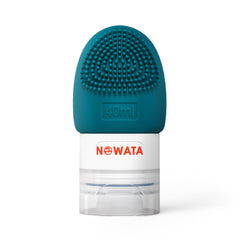

You shouldn't need a chemistry degree to feel confident about what's on your child's hands—but we have one, and that's exactly why we built something different.
As a dentist and a biomedical engineer raising young kids, we spent years watching our children's hands get coated in sanitizer residue right before they ate. We knew the science: alcohol-based sanitizers kill germs on contact but leave everything behind—the dead bacteria, the dirt, the chemical film. Our kids were eating all of it.
That frustration led us to two years of formulation work and a question the hygiene industry hadn't seriously asked: what if you could physically remove germs from skin instead of just killing them in place? The result is NOWATA™—a 100% plant-based, rinse-free soap with proprietary clumping technology that lifts and traps 99.9% of germs, dirt, and oil so you can brush them away entirely.* No water. No residue. No compromise.
In this guide, we share the doctor-parent perspective we couldn't find anywhere else: how common hand hygiene products actually work at the microscopic level, why removal outperforms killing when it comes to your child's skin, and the practical clean-hands routine we use with our own family every day.
TL;DR Quick Answers
How to keep kids' hands clean
The most effective way to keep kids' hands clean is to physically remove germs, dirt, and oil from the skin—not just kill them in place.
At home: Soap and water with 20 seconds of friction remains the gold standard.
On the go: Use a rinse-free soap that lifts and removes contaminants rather than a sanitizer that leaves dead germs, chemical residue, and dirt behind on the skin your child is about to put in their mouth.
Key moments that matter most:
-
Before eating or handling food
-
After playgrounds, parks, or shared surfaces
-
After bathroom use, coughing, or sneezing
-
After touching animals or pets
What to look for in a product:
-
Physical removal mechanism, not just chemical killing
-
Plant-based ingredients with no alcohol, parabens, or phosphates
-
Zero residue left on skin after use
-
Third-party lab testing with published results
As doctors who are also parents, we built NOWATA™ to close the gap between knowing when kids should clean their hands and having an effective option available wherever that moment happens—no sink, no rinse, no compromise required.
Top 5 Takeaways
-
Killing germs and removing them are not the same thing. Sanitizers neutralize germs in place. Dead microbes, dirt, oil, and chemical residue stay on skin. Physical removal lifts everything off entirely. NOWATA™ achieves that without water.
-
What's left behind matters as much as what's been killed. 16,000+ sanitizer exposure cases in children ≤12 reported in 2023. 84% involved kids four and under. Primary route: ingestion. Little hands go straight to little mouths.
-
Parents shouldn't have to choose between effective, safe, and convenient. Soap and water require a sink. Sanitizer leaves residue. Wipes don't remove germs. NOWATA delivers all three—doctor-made, Swiss lab-tested, 99.9% physical germ removal confirmed.*
-
Consistency matters more than counting. Focus on key moments: before meals, after playgrounds, after bathrooms. Have an effective option available at each one—whether you're at home or miles from a sink.
-
Plant-based doesn't mean less effective. Effectiveness depends on mechanism, not ingredient source. NOWATA was tested using the same ASTM E1174 framework that the FDA references for surgical hand scrubs. No alcohol. No parabens. No phosphates. Nothing left behind.

What's Actually On Your Child's Hands After Using Sanitizer?
Most parents assume hand sanitizer leaves hands clean. The reality is more complicated. Alcohol-based sanitizers work by killing bacteria and viruses on contact—but they don't remove anything. The dead microbes, the playground grime, the sticky residue from snack time, and the sanitizer chemicals themselves all stay right where they were. When your child puts their fingers in their mouth, thirty seconds later, they're ingesting all of it.
In our clinical and research backgrounds, we've studied how substances interact with skin at the molecular level. What we found surprised even us: the conventional approach to hand hygiene treats the symptom (live germs) while ignoring the actual problem (everything sitting on your child's skin). That distinction matters, especially for young children who touch their faces an average of 50 to 80 times per hour.
The Difference Between Killing Germs and Removing Them
Think of a muddy kitchen floor. You could spray disinfectant and kill every microbe in the mud—but you'd still be standing in mud. That's essentially how sanitizers work. They neutralize pathogens in place without lifting a single particle off the skin.
Physical removal takes a fundamentally different approach. Instead of attacking germs chemically, it binds to contaminants—dirt, oil, bacteria, viruses—and pulls them away from the skin's surface entirely. This is the principle behind traditional soap and water, and it's what the CDC has long recommended as the gold standard for hand hygiene.
The challenge has always been that physical removal required a sink, running water, and time. For parents and caregivers managing hand hygiene on the go, that combination is rarely available when you need it most.
How NOWATA's Clumping Technology Works
We spent two years developing a plant-based formula that achieves physical removal without water. When you apply NOWATA™ to skin and rub your hands together, the formula interacts with dirt, oil, and microbial particles and forms visible clumps—trapping contaminants inside. You then simply brush the clumps away, and the germs go with them.
This isn't a claim we make lightly. NOWATA™ was tested in a Swiss laboratory using a modified ASTM E1174 protocol—the same standard used to evaluate surgical hand scrubs. The results confirmed that our formula physically removed over 99.9% of tested virus and bacteria particles from skin.*
What's left behind is equally important: nothing harmful. Our formula is 100% plant-based, biodegradable, free from alcohol, parabens, and phosphates, and gentle enough for sensitive skin. We tested it on our own children first because we wouldn't offer your family anything we wouldn't trust with ours.
A Practical Clean-Hands Routine For Parents and Caregivers
After years of using NOWATA™ with our own kids and hearing from thousands of families, here's the approach we recommend for keeping children's hands consistently clean without relying on harsh chemicals.
Before meals and snacks: Apply a small drop of NOWATA™, have your child rub their hands together until clumps form, then brush off. The whole process takes about 20 seconds, and most kids find the clumping genuinely fun, which solves the compliance problem every parent knows too well.
After playgrounds, parks, and public spaces: This is where rinse-free removal matters most. Instead of layering chemical sanitizer on hands that are already dirty, NOWATA™ actually lifts the grime away. No sink hunting, no wet wipes adding to landfill waste.
During travel, sports, and outdoor adventures: Keep a bottle in your bag, car console, or backpack. At roughly 80 to 100 uses per bottle, a single tube covers weeks of family outings while saving up to two gallons of water per use.
At school and childcare: Teachers and caregivers tell us that NOWATA™ simplifies classroom hand hygiene routines significantly, particularly during cold and flu season when frequent washing causes dry, cracked skin on small hands.
Selecting A Hand Hygiene Product
Not every product marketed as "gentle" or "natural" lives up to those claims. When evaluating any hand hygiene product for your child, we recommend focusing on three things.
First, check the active mechanism. Does the product kill germs in place or physically remove them? Removal is what the science supports as most effective, especially for children.
Second, read the full ingredient list. Terms like "plant-derived" can mask synthetic additives. Look for products that are transparent about every ingredient and can point to independent lab testing—not just internal claims.
Third, consider what stays on the skin. Any product your child will inevitably put in their mouth should leave behind as little residue as possible. This is where the removal approach offers a clear advantage: if contaminants are physically gone, there's nothing left to ingest.
Clean Hands Shouldn't Require A Trade-off
We created NOWATA™ because we refused to choose between effective hygiene and our children's safety. Every parent and caregiver deserves that same confidence—knowing that when you clean your child's hands, you're actually making them cleaner, not just chemically treated.
Our formula is doctor-made, Swiss lab-tested, plant-based, and designed for real life with real kids. No water required. No harsh chemicals. No residue left behind.

"As doctors, we understood that killing germs in place isn't the same as removing them—but as parents, we felt the difference every time our kids put sanitizer-coated fingers straight into their mouths. That's why we spent two years engineering a formula that takes everything off the skin, not just neutralizes it there."
— Dr. Ruslan Maidans & Dr. Yalda Shahriari, NOWATA™ Founders
Essential Resources
We spent two years reading research papers, testing formulas, and consulting on testing protocols before we created NOWATA™. Along the way, we bookmarked the sources that actually helped us make better decisions for our own kids—not marketing fluff, but real science from organizations we trust.
Whether you're rethinking your family's hand hygiene routine or just trying to decode what's actually in that sanitizer bottle, these seven resources will give you the clarity you deserve. Consider this our recommended reading list, from one parent to another.
1. Start with the basics: the CDC's family hand hygiene guide
You'd be surprised how much we learned by revisiting the fundamentals. The CDC's family-focused hand hygiene page walks parents and caregivers through when children should clean their hands, how to teach the habit at different ages, and why building the routine early makes all the difference. If you read only one resource on this list, make it this one—it's the foundation everything else builds on.
Source: Centers for Disease Control and Prevention (CDC)
URL: https://www.cdc.gov/clean-hands/prevention/index.html
2. Understand how germs actually move from hands to mouths (and why removal matters)
Here's something that changed the way we thought about hand hygiene entirely: the CDC's handwashing science page explains that soap works primarily by physically lifting and removing germs from skin—not by killing them in place. That distinction is exactly what inspired NOWATA's clumping technology. Once you understand the mechanism, you'll never look at a bottle of sanitizer the same way.
Source: Centers for Disease Control and Prevention (CDC)
URL: https://www.cdc.gov/clean-hands/data-research/facts-stats/index.html
3. See what the world's leading health organizations now recommend for homes and schools
In October 2025, the WHO and UNICEF released their first-ever guidelines for hand hygiene in community settings—not hospitals, but the places where families actually live, learn, and play. As parents and scientists, we were glad to see the global conversation finally catching up to where it needs to be. These guidelines are worth your time, especially if your kids are in school or childcare settings.
Source: World Health Organization (WHO) & UNICEF
4. Get hand hygiene advice designed specifically for kids (from pediatricians who get it)
Not all hand hygiene guidance is created equal, and what works for adults doesn't always apply to little ones. The American Academy of Pediatrics' HealthyChildren.org page speaks directly to the reality of parenting: kids' hands are almost always visibly dirty, sanitizers don't work well on dirty hands, and getting a three-year-old to stand at a sink for 20 seconds can feel like an Olympic event. Sound familiar? This resource was written for you.
Source: American Academy of Pediatrics (AAP) via HealthyChildren.org
5. Check if the sanitizer in your diaper bag has been flagged by the FDA
This one might surprise you. The FDA has identified hand sanitizer products—including some marketed specifically to children—containing impurities like benzene and methanol at levels that exceed safety limits. Before you squeeze another drop onto your toddler's hands, it takes less than a minute to check whether your brand has been flagged. Your peace of mind is worth that minute.
Source: U.S. Food and Drug Administration (FDA)
6. Look up exactly what's in your child's soap, sanitizer, or wipes
We're big believers in reading the back of the bottle—it's what started this whole journey for us. The Environmental Working Group's Skin Deep® database lets you search any personal care product by name and see ingredient-level safety ratings based on published toxicity research. It's free, it's searchable, and it turns confusing ingredient lists into information you can actually act on. We use it ourselves and think every parent should have it bookmarked.
Source: Environmental Working Group (EWG) Skin Deep® Cosmetics Database
URL: https://www.ewg.org/skindeep/
7. Learn how hand hygiene products are actually tested (so you can ask better questions)
ASTM E1174 is the testing standard the FDA references when evaluating whether a hand hygiene product actually does what it claims. It's the same protocol framework—modified for our rinse-free approach—that we used to verify NOWATA physically removes over 99.9% of tested germs.* Most brands don't talk about their testing methodology. We think they should. Understanding this standard helps you separate verified science from clever packaging, and that knowledge protects your family more than any single product ever could.
Source: ASTM International
URL: https://www.astm.org/e1174-21.html
Supporting Statistics
Before we formulated a single batch of NOWATA™, we spent months in public health data—not as marketers, but as a dentist, a biomedical engineer, and two parents asking one question: why isn't there a better option?
Three statistics stopped us in our tracks. They're the reason NOWATA exists.
1. Physical germ removal prevents up to 30% of childhood diarrheal illness and 20% of respiratory infections
We knew from clinical training that soap works through mechanical action—friction, binding, and lifting. What we hadn't grasped was the scale of impact.
The CDC reports that handwashing prevents approximately 30% of diarrhea-related illnesses and roughly 20% of respiratory infections. For young children, that means soap could protect one in three kids who get sick with diarrhea and nearly one in five with respiratory infections like pneumonia.
The key insight for us was the mechanism behind those numbers. The CDC's science confirms that soap and friction lift dirt, grease, and microbes from skin so they can be rinsed away —physical removal, not chemical neutralization.
What this meant for NOWATA: Our question shifted from "could we build a rinse-free soap?" to "how do we deliver the removal mechanism the CDC describes without running water?" The answer became our clumping technology.
Source: CDC, "Handwashing Facts" — https://www.cdc.gov/clean-hands/data-research/facts-stats/index.html
2. Over 16,000 children were exposed to hand sanitizer in a single year—84% were four and under
We watched our own toddler lick sanitizer off her fingers at a grocery store entrance. Every parent knows that moment of helpless frustration. Then we pulled the data.
In 2023, U.S. poison control centers handled 16,058 hand sanitizer exposure cases in children 12 and younger. Approximately 84% involved children are aged four and under, the exact age when hand-to-mouth contact is constant and impossible to prevent.
The pattern is clear:
-
Over 31,000 exposure cases were reported in 2021 during peak pandemic sanitizer use
-
Numbers have dropped nearly in half since then, but remain significant
-
The primary route of exposure is ingestion—children putting sanitized fingers in their mouths
What this meant for NOWATA: We committed to zero alcohol, zero parabens, and zero ingredients we wouldn't want our daughter to accidentally taste. Not because the marketing sounded good, but because we'd watched it happen in our own home.
Source: AAPCC, via U.S. PIRG Education Fund — https://pirg.org/edfund/resources/poison-control-centers-have-probed-15000-cases-with-kids-and-hand-sanitizer-in-2021/
3. A standard faucet uses 2 gallons per minute—our family was sending 100+ gallons per week down the drain on handwashing alone
Engineers quantify things. So one week, we tracked our family's handwashing water use. The math was simple but hard to ignore.
The EPA states that a standard bathroom faucet runs at approximately 2 gallons per minute. Here's how that adds up for a family of four:
-
One 20-second handwash: roughly 0.75 to 1 gallon
-
20–25 family handwashes per day: 15 to 20 gallons
-
One week: over 100 gallons—just for hand hygiene
We don't advocate replacing every handwash. A sink is still the best option when available. But we started counting the moments each day when no sink existed:
-
The car after soccer practice
-
The picnic table at the park
-
The camping trip where water had to be rationed
-
The school lunch table between classes
Those moments made up a significant share of our family's hand hygiene needs—and each one was either going unaddressed, handled with chemical sanitizer, or wasting water unnecessarily.
What this meant for NOWATA: Each use saves up to two gallons. Over 80 to 100 uses per bottle, that's meaningful conservation built into a product we were going to use anyway. We didn't design it to lecture anyone. We designed it because once we saw our own family's numbers, we couldn't unsee them.
Source: U.S. EPA, WaterSense Statistics and Facts — https://www.epa.gov/watersense/statistics-and-facts
Final Thoughts and Opinion
After three years of reading CDC protocols, analyzing Swiss lab results, reviewing EPA water data, and testing hundreds of formula iterations on our own family, we've reached one clear conclusion: the conversation most parents are having about keeping kids' hands clean is missing the point entirely.
The industry has trained us to ask the wrong question. We compare alcohol percentages, fragrance options, and label claims—debating which sanitizer is "gentlest" or which soap is "most natural." But the question that actually matters is simpler: what happens to the germs?
They either stay on your child's skin or they don't.
The real problem: every existing option asks parents to compromise
We lived in this gap for years before we decided to close it. Here's how the trade-off breaks down:
-
Effective + safe = soap and water. But it requires a sink, 20 seconds of running water, and a level of toddler cooperation that's aspirational at best. Not convenient.
-
Effective + convenient = alcohol-based sanitizer. But 16,000 children a year end up in poison control databases, and every application leaves chemical residue on the skin that your child is about to put in their mouth. Not safe enough.
-
Safe + convenient = wipes or water-only rinses. But neither achieves meaningful germ removal. Not effective.
Parents have been told to pick two. We rejected the premise.
What changed our thinking—and what we built instead
Dr. Yalda would pack a bag for the park with snacks, wipes, sanitizer, and a quiet sense of resignation that none of those options were truly good enough. Dr. Ruslan would watch their daughter rub sanitizer into hands that were about to hold a sandwich—and think about everything he knew about dermal absorption and ingestion pathways.
We were both doing what every parent does: making the best choice available while knowing it wasn't the right one.
NOWATA™ came from refusing to accept that compromise. We believed a plant-based formula could achieve genuine physical removal without water. We spent two years proving it in a Swiss laboratory using the same ASTM E1174 testing framework the FDA references for surgical hand scrubs. When the results confirmed 99.9%* removal of the tested virus and bacteria particles, we didn't celebrate a product launch. We exhaled.
We'd built the thing we wished had existed when our kids were born.
What NOWATA is—and what it isn't
We want to be straightforward:
-
It is not a replacement for soap and water when a sink is available
-
It is not a medical product, and it does not prevent disease
-
It is the only doctor-made, plant-based, rinse-free soap that physically removes 99.9% of tested germs through a mechanism the science actually supports*
What that means in practice:
-
No alcohol
-
No chemical residue
-
No water wasted
-
No compromise required
One thing to take from this page
If you remember nothing else we've shared here, let it be this: you deserve to feel as confident about what's on your child's hands after cleaning them as you do about getting them clean in the first place.
Next Steps
You've seen the research. You've reviewed the data. Now put that knowledge to work with five steps you can take today.
1. Audit what's currently in your bag
Pull out your hand hygiene products and ask three questions:
-
Does it remove germs or just kill them in place?
-
Does the ingredient list include alcohol, parabens, phosphates, or anything you can't identify?
-
After your child uses it, would you want those fingers going straight into their mouth?
If any answer gives you pause, you're not overreacting. You're paying attention.
2. Look up what's in your products
-
Search your current products by name or ingredient
-
See exactly what's touching your child's skin—and what's being left behind
One search. That's all it takes to make more informed choices.
3. Try NOWATA™ for yourself
Physical germ removal is best understood by feeling it work:
-
Apply a small drop to dry hands
-
Rub until the formula clumps—trapping dirt, oil, and contaminants
-
Brush off the clumps and everything they've captured
No water. No residue. No guesswork. See it at nowataclean.com.
4. Build a routine that fits your life
Match the right tool to the right moment:
-
At home, sink available: Soap and water. Still the gold standard.
-
On the go, no sink in sight: NOWATA in your bag for playgrounds, trails, road trips, sports, and classrooms.
-
In a pinch, no other option: A water-only rinse beats nothing—but know what it doesn't remove.
The goal isn't perfection. It's being prepared.
5. Share what you've learned
-
Forward this page to a parent who needs to see it
-
Start the conversation at your next playdate
-
The more families understand the difference between killing germs and removing them, the better choices all of us can make
Frequently Asked Questions
Q: What is the most effective way to keep kids' hands clean when there's no sink available?
A: After two years of lab development and three years of real-world testing on our own children, we can say with confidence: physical removal beats chemical killing every time.
We've tried every alternative as both doctors and parents. Here's what we found:
-
Wipes smear contaminants around rather than removing them
-
Sanitizers neutralize some germs but leave everything sitting on the skin
-
Water-only rinses miss the oil and residue entirely
That frustration is why we engineered NOWATA™. Our plant-based clumping technology works the way soap and water do—lifting and trapping dirt, oil, and 99.9% of tested germs so you can brush them away completely.*
We keep a bottle in our diaper bag, hiking pack, and both car door pockets. After hundreds of playground visits, camping trips, and roadside snack stops, it's the one product that's never failed us when a sink wasn't an option.
Q: Is hand sanitizer safe for kids to use regularly?
A: This question started our entire journey.
Dr. Ruslan watched our daughter squeeze sanitizer onto her hands at the playground and immediately reach for a cracker. As a dentist who understands oral absorption, he knew exactly what was happening—alcohol, fragrance compounds, and inactive ingredients going straight from skin to mouth.
The data confirmed what we were seeing firsthand:
-
16,000+ hand sanitizer exposure cases in children ≤12 years reported in 2023
-
84% involved children were aged four and under
-
Primary route: ingestion from putting sanitized fingers in mouths
Source: American Association of Poison Control Centers
Sanitizers are generally recognized as safe when used as directed. But toddlers don't read directions. If your child can keep their hands out of their mouth until the product fully dries, sanitizer works in a pinch. In our experience raising small children, that's a big "if."
It's why we built a formula that leaves nothing behind to worry about.
Q: How often should kids wash or clean their hands during the day?
A: We used to count. Then we realized consistency matters more than numbers.
The CDC recommends hand cleaning at these key moments:
-
Before eating or preparing food
-
After using the bathroom
-
After playing outside or touching shared surfaces
-
After coughing, sneezing, or blowing their nose
-
After touching animals or pets
In our household, that adds up to roughly 8–12 hand cleanings per day per child. We found that maybe half happened near a working sink. The rest were in the car, at the park, on a trail, or in a checkout line.
That gap—between knowing when to clean and having an effective way to do it—is the problem we set out to solve.
Our kids now reach for NOWATA the same way they'd reach for a faucet. It's just part of the routine, wherever we happen to be. The habit matters more than the count.
Q: What's the difference between killing germs and removing them from skin?
A: This distinction changed everything about our product development.
Early in our research, Dr. Yalda ran a simple visual test. She applied hand sanitizer to a surface coated with a UV-reactive soil compound. The result:
-
✅ Sanitizer killed the test organisms
-
❌ Under UV light, the soil compound was still sitting right where it started
-
❌ Dead germs, dirt, oil, and chemical residue—all still present
Killing ≠ removing. Physical removal, which is how soap and water work, uses friction and surfactants to lift contaminants off the skin entirely.
We engineered NOWATA's clumping technology to achieve that same result without water:
-
Plant-based formula binds to everything on the skin's surface
-
Visible clumps form that you can see and feel
-
You brush away the contaminants—germs included
Swiss laboratory testing using a modified ASTM E1174 protocol confirmed 99.9% removal of tested virus and bacteria particles.* Once you watch the clumps come off your child's hands, the difference becomes impossible to ignore.
Q: Are plant-based hand soaps effective enough to keep kids safe from germs?
A: We've heard this skepticism hundreds of times—from retail buyers, investors, even family members. We understand it. "Plant-based" has been used so loosely in personal care that it's become a trust problem.
That's exactly why we insisted on independent verification:
-
Testing facility: Swiss laboratory
-
Protocol: Modified ASTM E1174—the same framework the FDA references for surgical hand scrubs
-
Result: Over 99.9% physical removal of tested virus and bacteria particles*
Effectiveness depends on the mechanism, not the ingredient source. A plant-based formula that physically removes contaminants can outperform a synthetic formula that only kills them in place—because removal eliminates the problem.
What NOWATA doesn't contain:
-
No alcohol
-
No parabens
-
No phosphates
-
No harsh chemicals
-
No residue left behind
As parents with backgrounds in chemistry and biomedical engineering, we formulated NOWATA to be the product we'd trust in our own children's hands before a meal. That's not a compromise. In our experience, it's a higher standard.
Your kids deserve clean hands without the chemical trade-off—NOWATA™ makes it possible
Discover the doctor-made, plant-based soap that physically removes 99.9%* of germs with no water, no rinse, and nothing left behind. Shop now at nowataclean.com.
*Based on laboratory testing using a modified ASTM E1174 test, NOWATA physically removed over 99.9% of virus (Murine Norovirus, a human norovirus surrogate) and bacteria (E.Coli) particles from skin. Results do not imply disease prevention. For hand cleansing only.
Leave a comment