




In the spring of 2022, 222 rafters and backpackers came down with a stomach bug in the Grand Canyon backcountry. When the CDC went in to work out why, one detail stopped us cold: many of the outfitter staff had no idea that alcohol-based hand sanitizer does almost nothing against norovirus.
Neither did most of the hikers, presumably. Sanitizer is the thing everybody packs for exactly this job.
We're a dentist and a biomedical engineer. We're also the parents of two kids who touch every handrail in North America, and we spent two years on a hand soap for them before we sold a tube to anybody else. Somewhere in that stretch we quit asking how to kill the most germs and started asking a better question. How do you get germs off a pair of hands when the nearest sink is 15 miles away?
TL;DR Quick Answers
Outdoor Hand Hygiene
Outdoor hand hygiene means cleaning your hands at four specific moments, using a method that works without plumbing and doesn't leave soapy water on the ground. If you have water, wash with a biodegradable soap at least 200 feet from any stream or lake, then scatter what's left over a wide area. If you don't, use a rinse-free soap that lifts dirt and germs off your skin so there's nothing to pour out.
The short version:
-
The four moments. Before you handle food, after a privy or cathole, after you touch shared gear, and after contact with animals, fish, or fuel.
-
With water. Biodegradable soap, 20 seconds of scrubbing, 200 feet from the source, greywater scattered wide.
-
Without water. Rinse-free soap removes soil and germs. No rinse means no greywater to deal with.
-
About sanitizer. It's the weakest option. Alcohol struggles with dirty hands, and it struggles with norovirus.
-
Timing beats frequency. Two washes at the right moments do more than six at random.
Top 5 Takeaways
-
Sanitizer was built for clean hands. The National Library of Medicine puts it plainly: soap and water are preferable when hands are visibly soiled or dirty. Outdoors, that's every hand, nearly all the time.
-
Norovirus is the backcountry's real problem. Alcohol barely touches it, because there's no fatty outer coat for the alcohol to break apart, and the virus survives for days on privy latches, shelter tables, and the spigot everybody shares. It moves fast.
-
Anything you rinse becomes greywater. Soapy water has to be strained, scattered, and kept 200 feet from anything you'd drink. The word "biodegradable" on the bottle changes none of that.
-
Removal beats masking when hands are dirty. Kill a germ in place and the dead cell stays on your skin. So does the dirt it arrived on. Lifting both off takes both away.
-
Clean hands protect your group more than a better filter does. Most backcountry stomach bugs travel person to person and surface to hand. Not through the water you treated.

Why Hand Sanitizer Falls Short When You're Outside
Alcohol sanitizer was built for one setting. Reasonably clean hands, in a clinic or an office or a classroom. It does that job well, and we'd never tell you to leave it home. Take it outdoors, though, and two things go sideways.
It doesn't handle dirt. Federal health guidance is direct on this point, and so is the back of any sanitizer bottle: soap and water win when hands are visibly soiled or greasy. Picture your hands after 4 hours of sunscreen, sweat, trail dust, campfire soot, and a granola bar wrapper. That's the precise condition alcohol handles worst.
Then there's norovirus. It's non-enveloped, meaning there's no fatty coat for alcohol to dissolve, and it spreads with almost no help at all. A few particles will do it. It sits on shelter tables and privy latches long after the hiker who left it there has walked on. The Appalachian Trail Conservancy now warns hikers outright that alcohol-based sanitizer may be ineffective against it.
One more thing worth saying without softening it. Sanitizer kills some of what it reaches and then leaves every bit of it right where it was. Dead cells on your skin. Dirt on top of them.
Soap works the other way. It binds to dirt, oil, and germs, then carries the whole mess off your hands. That's why washing outperforms sanitizing on visibly dirty hands, and outdoors, hands are visibly dirty as a matter of course. We put the two mechanisms side by side in our breakdown of rinse-free soap versus hand sanitizer.
How To Wash Your Hands Outdoors, With Water Or Without
When You Have Water
Car camping, established campgrounds, anywhere water isn't the thing you're short of. Getting clean is the easy part here. Keeping the dirty water out of everything else takes a little discipline.
-
Collect and treat your wash water first. Untreated water on your hands right before dinner rather defeats the point.
-
Walk 200 feet from any stream, lake, or spring. The PCTA counts that as about 80 steps, and it's farther than almost anyone guesses.
-
Wet, lather with a biodegradable camp soap, and scrub for 20 seconds. Between the fingers. Under the nails.
-
Rinse over a container or a wide patch of durable ground. Never back into the water source.
-
Strain the food solids out, pack them with your trash, and scatter the rest broadly.
-
Keep the handwashing setup away from the dish station. Mixing the two is a classic group-trip mistake, and it's the kind that spreads.
For a basecamp or a larger group, a hanging jug with a spigot or a simple tippy tap earns its weight fast. It saves water, and it gets people washing more often, because the effort drops to almost nothing.
When You Don't Have Water
This is the harder version of the question, and it's the one most guides fumble. A rinse-free soap answers it by removing the rinse step rather than working around it.
-
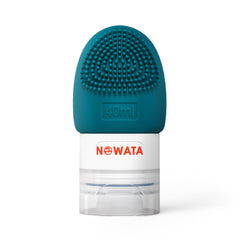
Put a dime-sized drop of NOWATA on dry hands. No water, no pre-wetting.
-
Rub for about 45 seconds, until the formula clumps. Those clumps are the dirt, oil, and germs binding to the soap.
-
Brush the clumps off over a cathole, a trash bag, or bare durable ground, well away from water.
Independent Swiss lab testing, performed on a modified ASTM E1174 protocol, measured over 99.9% removal of E. coli and a norovirus surrogate from skin.* One tube runs 80 to 100 uses, which covers most of a season.
*Based on laboratory testing using a modified ASTM E1174 test, NOWATA physically removed over 99.9% of virus (Murine Norovirus, a human norovirus surrogate) and bacteria (E.coli) particles from skin. Results do not imply disease prevention. For hand cleansing only.
One tube fits the TSA carry-on limit too, which matters more than you'd think when the trailhead needs a flight to reach. We covered the packing side of that in our guide to portable hand soap for travel, camping, and hiking.
And if you've got nothing at all? The old method still beats shrugging. Dry sand, cold ash, or snow, worked in hard, then keep your hands off your face until you can do better. Not clean. Cleaner.
Leave No Trace, Soap, And Where The Greywater Goes
That 200-foot rule comes out of Leave No Trace, a set of outdoor ethics built to keep wild places usable for whoever shows up next. Nearly every land manager in the United States teaches it now, and it applies to soap whether or not the label says biodegradable.
People misread that word constantly. Biodegradable describes what happens in soil, where microbes break down soap. It says nothing about what happens in a creek. Pour even a plant-based soap into moving water, and you shift the chemistry, which the insects and fish living there feel long before you do.
So the honest rule for washing outdoors is mildly inconvenient, and it's worth following anyway. Carry water away from the source, wash there, scatter the rest wide, and let the soil do its work. The U.S. Forest Service and the Pacific Crest Trail Association both spell out the same practice for anyone on federal land or a long trail.
Rinse-free soap steps around the whole problem instead of managing it. No rinse, no soapy water, nothing to disperse. You brush the clumps off, pack out an empty tube, and leave the site the way you found it. That's a difference in category, not a difference in marketing, and it's most of the reason we built the thing.
What Changes By Trip Type
The four moments hold everywhere. What shifts is the constraint you're fighting.
-
Day hikes and trail runs. One moment really matters, and it's lunch. A small tube in a hip belt pocket covers the whole day.
-
Car camping. Water isn't scarce, so the work is greywater and keeping your stations separate. Set the handwashing jug before someone gets hungry.
-
RV, van life, and dispersed camping. Your freshwater tank is finite, and your greywater tank fills faster than you'd think. Every rinse-free wash is water you keep and wastewater you never make.
-
Paddling, fishing, and hunting. Wet hands, fish slime, game handling, and nothing dry to work with. Removal counts for more here than anywhere, because there's real organic material to get off your skin.
-
Outdoors with kids. Highest frequency, lowest compliance, by a mile. Ours will do it happily when the result is something they can watch roll off their fingers.
-
Backpacking and thru-hiking. Weight, shared shelters, and outbreak season all land on you at once. This is where the choice of soap actually earns its ounce, and we went deeper on it in our guide to choosing a hand soap for hiking and backpacking.

“We tested this on our own kids for two years before anyone else's, and the surprise was how little germ-killing had to do with it. On a trail, what you pull off your skin matters more than what you leave behind dead."
— Dr. Ruslan Maidans, DDS, NOWATA co-founder
Essential Resources On Outdoor Hand Hygiene
Six sources worth 10 minutes before your next trip. Each one comes from a different organization, and each answers something this guide only partly covers.
1. Why Lifting Germs Off Beats Killing Them In Place
The National Library of Medicine explains how soap lifts dirt and germs from skin, and says outright that soap and water beat sanitizer when hands are visibly soiled. That's the trial conditions, described exactly.
Source: MedlinePlus, Handwashing
2. What Camp Hygiene Actually Looks Like In Practice
The National Park Service walks through real backcountry hygiene, from what to pack to how far to stay from water. It's the most usable government guidance on the subject.
Source: National Park Service, How To Maintain Personal Hygiene While Camping
3. The Truth About "Biodegradable" Soap
Leave No Trace explains why getting any soap into a water source is off the table, biodegradable or not. If you read one thing on this list, read this one.
Source: Leave No Trace, The Skinny On Soap
4. How A Stomach Bug Moves Through A Trail Community
The Appalachian Trail Conservancy tracks norovirus on the A.T. and gets specific about shelters, shared food bags, and when to get off trail. It also tells hikers plainly that alcohol sanitizer may not help.
Source: Appalachian Trail Conservancy, Norovirus & Stomach Bugs
5. Where Human Waste Goes, And Why Your Hands Care
Almost every stomach bug on this page travels the same route, and it starts in a cathole. The Bureau of Land Management gives specifics on dispersed camping. Pack it out where you can, or bury it 6 to 8 inches deep and 200 feet from water and trails.
Source: Bureau of Land Management, Camping On Public Lands
6. Greywater Rules Written For Long-Distance Hikers
The Pacific Crest Trail Association covers washing and greywater from a thru-hiker's point of view, where every ounce and every water source counts twice. Their advice: minimize soap entirely, and keep it 200 feet out.
Source: Pacific Crest Trail Association, Leave No Trace
Supporting Statistics
We built NOWATA around what we kept hitting on our own trips, then went and checked it against the numbers. Three of them stuck.
1. One Outbreak Sickened 222 People In A Single Season
-
Between April 1 and June 17, 2022, 222 rafters and backpackers met the case definition for acute gastroenteritis in the Grand Canyon backcountry. It's the largest outbreak the park has ever documented.
-
Attack rates on individual rafting trips ran from 10% to 83%. On one trip, 29 of 35 people got sick.
-
Portable toilet specimens from all nine affected trips tested positive for norovirus.
-
CDC investigators noted that many outfitter staff were unaware alcohol-based hand sanitizer does not mitigate norovirus transmission. That single line reshaped how we talk about this.
2. The Average American Family Uses More Than 300 Gallons Of Water A Day
-
The EPA puts household use above 300 gallons daily, with roughly 70% of it happening indoors.
-
That's the baseline you leave at the trailhead. On trail, every gallon gets carried or filtered by hand.
-
A backpacker carries 2 to 4 liters. Under a gallon, for everything, drinking included. That gap is the actual design problem.
-
Skipping the rinse saves about 2 gallons per wash, which runs past 100 gallons over a single tube.
Source: U.S. EPA WaterSense, How We Use Water
3. A Record 175.8 Million Americans Went Outdoors In A Single Year
-
Outdoor recreation hit a record 175.8 million participants in 2023, which is 57.3% of everyone in the country aged six and older.
-
7.7 million of them tried an outdoor activity for the first time that year. Compared with 2019, 22.2 million more Americans were getting outside.
-
Nobody arrives on their first trip knowing the 200-foot rule, or why sanitizer struggles once your hands are dirty. The crowd is growing faster than the habits are spreading, and that gap is what this guide exists to close.
Source: Outdoor Industry Association, Outdoor Participation Hits Record Levels For Ninth Consecutive Year
Final Thoughts And Opinion
Here's our honest read after a lot of miles and a lot of lab time.
The outdoors has never been short on ways to clean your hands. What it lacked was a better question. Nearly every product in this category opens by asking how to kill the most germs. We opened by asking how to get them off your hands without leaving something worse behind, and the answer we landed on looks nothing like a sanitizer bottle.
What we'd actually tell you over a campfire:
-
Timing beats frequency. Two washes at the right moments outperform six scattered ones.
-
Treat sanitizer as your backup. Fine on clean hands, weak on dirty ones, which is backwards for outdoor use.
-
Take greywater seriously. It's the step everyone skips, and it's the one the next group notices.
-
With kids, make it visible. They'll wash for a result they can see and skip it for one they can't. Ours are proof.
Our opinion, stated straight: on a trail, pulling germs off your skin beats masking them, and skipping greywater beats managing the biodegradable kind. We were parents before we were a soap company. This is the version of hand hygiene we could actually get our own kids to do without a fight, and safe enough for toddler snack hands is the same bar as tough enough for trail grime.
Frequently Asked Questions
Q: How Do You Wash Your Hands Camping With No Water?
A: Use a rinse-free soap. Dime-sized drop on dry hands, rub for about 45 seconds until it clumps, brush the clumps off away from any water source. The dirt, oil, and germs go with them, and there's no rinse water left to deal with.
Q: Does Hand Sanitizer Kill Norovirus?
A: Not reliably, no. Norovirus is non-enveloped, so alcohol has no fatty layer to break apart. CDC investigators flagged this during the 2022 Grand Canyon outbreak, and the Appalachian Trail Conservancy now warns hikers about it directly. Wash when you can.
Q: How Far From A Lake Or Stream Should I Wash My Hands?
A: At least 200 feet, which the Pacific Crest Trail Association counts as about 80 steps. That covers the washing and wherever you scatter the used water. Most people badly underestimate it, so pace it out once, and you'll have the feel for good.
Q: Is Biodegradable Soap Safe To Use In A Stream?
A: No. Biodegradable describes how soap breaks down in soil, not in water. In a stream, it still shifts the chemistry and affects what lives there. Keep it 200 feet out every time, whatever the bottle claims.
Q: Is Hand Sanitizer Enough For A Backpacking Trip?
A: On its own, no. It works on hands that are already clean, and backpacking hands almost never are. Carry something that removes dirt, and let sanitizer be what you reach for afterward.
Q: How Do I Get Kids To Actually Do This Outdoors?
A: Make the result visible. Ours were completely unmoved by anything invisible, but watching the grime roll off in little clumps turned it into something they asked to do. Tie it to a fixed moment, like right before snacks, and it stops being a negotiation. There is more on the habit side in our doctor guide to keeping kids' hands clean.
Q: Do Rinse-Free Soaps Really Remove Germs, Or Just Move Them Around?
A: They remove them, assuming the formula was built for it. NOWATA binds dirt, oil, and germs into clumps that leave your skin when you brush them off. Independent Swiss lab testing on a modified ASTM E1174 protocol measured over 99.9% removal of E. coli and a norovirus surrogate in about 45 seconds.*
*Based on laboratory testing using a modified ASTM E1174 test, NOWATA physically removed over 99.9% of virus (Murine Norovirus, a human norovirus surrogate) and bacteria (E.coli) particles from skin. Results do not imply disease prevention. For hand cleansing only.
Q: How Many Uses Do I Get From One Tube?
A: Between 80 and 100. At a wash or two a day, one tube covers a long trip or most of a season, and it weighs a fraction of the water it replaces.
Pack Clean Hands For Your Next Trip
Outdoor hand hygiene gets simple the moment you carry something that works with no sink, no rinse, and no bag of wet trash to haul out. Shop NOWATA rinse-free soap at NowataClean.com and clean up wherever you happen to be standing.
*Based on laboratory testing using a modified ASTM E1174 test, NOWATA physically removed over 99.9% of virus (Murine Norovirus, a human norovirus surrogate) and bacteria (E.coli) particles from skin. Results do not imply disease prevention. For hand cleansing only.
Leave a comment